Going up!


This slideshow requires JavaScript.

Going up to Wardshurst farm or going down to the Coombe, either way it was tricky for the Thursday volunteers carrying out much needed restoration work to the Coombe steps. – new step boards, infilling, with posts and rails. This was probably the hardest task set by the Trust in years and was a new location for the volunteers, deep down on the side of the valley on part of the Boundary Trail. The Coombe is a deep short valley without a watercourse, blocked at one end making it difficult to enter with vehicles or even on foot. The path in question gave access to the inhabitants of the lost hamlet of Wards, when travelling to Ringshall and Little Gaddesden, clearly shown on the Estate map of 1762.
The word “hurst” has Anglo-Saxon origins referring to a wooded hillside, and it seems that the Coombe has been part wooded since at least 1656. Artefacts that have been discovered suggest that it has seen human activity since the Bronze age some two thousand years ago. A Roman cemetery, a lost hamlet, brick making, quarrying, and rabbit rearing have all featured in it’s history. Being part of the common of Ivinghoe Aston it would have had grazing livestock, with wood pasture for cattle and pigs in season.
The earliest reference to the lost “hamblet” of Wards was in 1578 when it was referred to as a “tything”. This was an Anglo-Saxon legal concept being a group of ten households or families who swore a pledge to the King for good behaviour. The responsibility for keeping the peace within the community lay with an elected tithing – man. Squatters encroaching on common land for the purpose of habitation, were often accepted by the manorial lord as a source of revenue, especially where it could lead to a settlement for trade. Today the only surviving evidence of the hamlet is an ancient well.
An interesting insight into customary rights on the common comes from an agreement of 1656, drawn up between John 2nd earl of Bridgewater, Lord of the Manor, and a group of his tenants.
It emphasises the importance of common rights held by both the Earl’s tenants and those owning land in the Wards Hurst hamlet. Of particular interest is the mention of John South of Wardshurst farm having the right to enclose one acre of waste ground so long as he allows passage of animals from the hamlet to the pond.
The 1656 agreement provides the first reference to the existence of a rabbit warren within the Coombe, referring to “Box Warren”. In England the number of rabbit warrens had increased steadily in the later 14th and the 15th centuries. Commons were often used as they represented marginal or waste land. A grant of free warren permitted manorial lords to establish colonies of rabbits, or conies as they were then known, regardless of the impact it might have on the commoners’ grazing. For the Ivinghoe Aston commoners it appears that the rabbit population was out of control and damaging the resources of the common. The solution seems to have been to fence the area of the warren and to allow the commoners to catch rabbits outside of it’s boundaries. As part of the plan, box, which is native to the area was planted in rows to create hedges to provide cover for the rabbits. Despite being coppiced over the centuries, the hedges still remain to this day. Rabbits were reared for their fur and meat, but by the mid 1700’s the market had declined, so the ever resourceful Bridgewaters took to the felling of the box trees. The timber became very desirable for printing blocks and musical instruments, and it was shipped off to the London wood turners.
The volunteers will be back to finish the job!

Posted in Uncategorized | Leave a comment

Bluebirds over………


This slideshow requires JavaScript.

The swathe of countryside above the White Cliffs of Dover could be sold to developers if the National Trust cannot raise £1 million in three weeks to buy one of Britain’s most important landscapes. The Trust currently manages the threatened five miles of the chalk cliffs and in 2012 bought a mile long section to protect the area for the nation. Recently it learned that the landowner is planning to sell off the managed area, prompting fears that without intervention the one hundred and seventy three acre expanse of rolling chalk cliff tops could be altered forever by developers.

Now the Trust has launched an urgent appeal claiming it would be ‘devastating’ if it lost the chance to protect the site. The unspoiled cliffs are planted firmly into the nation’s consciousness as the gateway to Britain, and played a crucial part in the country’s military history, overlooking the English Channel towards France. The cliff tops, which have inspired artists and writers for centuries, are still home to slit trenches and an important battery and range-finding station from the Second World War.

The bid is being supported by Dame Vera Lynn, who’s 1942 war ballad The White Cliffs of Dover secured her reputation as the Forces Sweetheart“Those iconic white cliffs mean a great deal to so many people,” she said. “They were often the first sight of home for our brave boys as they returned from war, and they continue to represent important British ideals such as hope and resilience even in the most difficult of times. It is vital that we do all that we can to preserve this important historical site, as well as the Cross Channel battery, for posterity, so that the memory of the past is never forgotten by future generations.” In March Dame Vera Lynn’s image was projected onto the cliff face.

The White Cliffs are a haven for nature and wildlife with more than forty species of flowers and grasses every square yard, including the Early Spider Orchid and Viper’s Bugloss. The chalk-lands provide a crucial habitat for butterflies such as the Adonis Blue and Marbled White, and birds including the peregrine falcon and the skylark.

If successful The National Trust will continue to restore the downland habitat. It is believed that the land purchase will cost around £2.5 million and the Trust is using money from it’s Neptune coastal fund towards the cost of the purchase, but it needs to raise a further £1 million by September 22nd to secure the land, which is owned by a local farmer.

Should the Trust’s bid become successful, plans are in place to restore the chalk grasslands, make the military structures watertight, and create new access routes for visitors. Historically, the short downland turf on top of the cliffs was created by allowing animals to graze. However, modern farming techniques including the use of fertilizers, herbicides and even tractors, can easily destroy it and the National Trust has been using Exmoor ponies to graze the land that it owns to restore the traditional landscape. 

Virginia Portman, General Manager at the property says: “There is something very special about the White Cliffs and for many people the site represents part of our cultural heritage. This unique coastal habitat is teeming with wildlife and being adjacent to land already in our care will provide better management options for the area. The site should be open for the whole nation to enjoy. It would be devastating if we lost the opportunity to protect it forever. A successful appeal will not only allow us to secure the land but also educate and inspire future generations.”

Donations that come in after 22 September, or after the appeal has reached £1 million, will support ongoing work to protect this and other precious coastal landscapes across the UK.

Money can be donated to the appeal online here.

This acquisition is in keeping with the original aims and objectives of the Trust way back in the days of Octavia Hill – being a custodian of our treasured landscape. It is a safe bet that the purchase will go ahead since the Trust have considerable reserves from which to underwrite the purchase, with available funds now exceeding £48 million pounds.

Thanks to Sarah Knapton for the details.

Posted in Uncategorized | 1 Comment

Horses for Courses!


This slideshow requires JavaScript.

The fourth Ashridge fun-ride taking around two hours to complete was held on Sunday, over nine miles using some tracks not normally open for riders. Some thirty five horse-riders were able to navigate around the Beacon hills with the help of the volunteers, and the co-operation of the tenant farmers – volunteers acted as marshals and gate-keepers. There is a permitted horse-route around the Beacon for permit holders from Piccadilly hill to the Bus-stop car park, but this is rarely used. The last time that an organised horse meeting took place here was probably way back in the early 1700’s when there was a race course in the area, some two hundred and fifty years ago.

The Ashridge Estate map of 1762 shows two arable fields called “Horse race piece” on level ground south east of the Beacon, and to the east of Piccadilly Hill. This suggests that the area was used for horse racing before the field enclosures. The area was no doubt a meeting place for the Welsh drovers, on their way to London and the southern counties, and when horse riders get together in any number, they invariably choose to race their steeds. Their horses were a mountain breed with an uneven gallop, but they would only need a short stretch of dry level ground, like chalk grassland. Thoroughbred racing did not become common place in England until the mid 1700’s by which time all of the English classic races had been established. Thoroughbreds were first imported at the beginning of the 1700’s, when regular racing had been established at Newmarket under the patronage of Charles II. Francis Bridgewater the “canal” Duke (Ashridge 1748-1803) indulged in the fashionable pursuit of horse racing and breeding, keeping a house and stables at Newmarket. He sold his horses at the Robin Hood inn in Little Gaddesden and may have used the Ward’s-coombe course. Scroop the first Duke of Bridgewater (Ashridge 1701-1745) had some one hundred and fifty horses on the estate, including race horses and no doubt trained his horses on the course.

Mr Ellis the well known diarist from Little Gaddesden tells us that in the early 1740’s a certain Mr Hearne, a gypsy who lived a while at Brick Kiln cottage on Berkhamsted common along with some thirty compatriots, was “full of money”, and kept a couple of race horses. He ran a little black bay-horse against a Gentleman’s large grey at Ward’s -coombe, and won a great deal of money by a particular “bite” – a cunning plan. His horse in the first race was secretly restricted in it’s gallop, so he deliberately lost the race. A large amount of money was then wagered by the “locals” on the second race expecting a similar outcome, but the restrictive harness had been removed from the bay-horse without their knowledge, and Mr Hearne won the race easily. The cunning plan had worked and Mr Hearne had cleaned up!  

Today’s horse-riders are particularly welcome at Ashridge because they add so much charm to the bucolic scene.

Posted in Uncategorized | 2 Comments

Another Pick & Mix


pick 7 mix

The packed program of special events continues through the Autumn and Winter at Ashridge – The following list will help you when organising your volunteering time-table for the next four months. There are at least fifteen events to consider – twice as many as last year. You can join the event as a visitor, or volunteer to help, by contacting helpingashridge to register your interest.

Sunday 3rd September Fun Ride 9.00am-11am
Act as a marshal or ride your own horse.

Tuesday 12th September Golden Valley Stroll 10 30am-12 30pm
Join the volunteers for a walk in the footsteps of Capability Brown.

Saturday 30th September, Sunday 1st October Tree-mendous Ashridge 10am – 4pm
A week-end celebrating and identifying ancient trees. Join the guided walks.

Saturday 30th September The Ancient Trees of Aldbury Common 11am – 1pm
A guided walk by the rangers.

Saturday 7th October Ashridge In Autumn Walk 10am – 2pm
A volunteer-led guided walk.

Friday, Saturday, Sunday 13th to 15th October Deer Rut Walk 7am – 9am
Join the rangers for an early morning walk including breakfast.

Friday, Saturday, Sunday 20th to 21st October Deer Rut Walk 7am – 9am
Join the rangers for an early morning walk including breakfast.

Wednesday 18th October A Gentle Stroll to look for Deer 10.30am – 12.30 pm
A volunteer-led walk.

Monday 23rd to Friday 27th October A Halloween Trail 10am – 4pm
Spooky crafts at the Visitor Centre all week.

Monday 27th November to Monday 8th January Christmas Pudding Walk 10am – 4pm
A self-led walk through the woods.

Wednesday 6th & Monday 11th December Wreath-making Workshops 1pm – 3.30pm
Christmas decorations created from the Estate’s greenery

Saturday & Sunday 2nd 3rd 9th 10th 16th 17th 23rd 30th & 31st Christmas Trail 10am – 3pm
Follow the creatures of Ashridge on the trail.

Sunday 10th December Santa Paws Walk 12pm – 1pm
Dress up your dog in Christmas clothes for a walk.

Sunday 17th December Jingle Ponies 11am – 12pm
Watch the fancy dress parade by local horse riders.

Tuesday 26th to Friday 29th December Children’s Craft 10am – 3pm
Help make paper wreaths with the children.

Wednesday 27th December Post- Christmas Walk 10am – 12pm
Enjoy a scenic walk through the Estate.

Posted in Uncategorized | 1 Comment

Recollections


combineharvest time 1964

Our last post on harvest-time set some fifty years ago proved inspirational for one of our volunteer members. It triggered recollections of happy boyhood days growing up on a rural Herefordshire farm deep in the countryside. This is some of what he had to say:
“My mum and dad did not own the farm, but the owner lived on a larger farm nearby in Stoke Lacey, and my dad worked for him as a farm worker. I was born on the farm in 1942 and it was fairly remote with the nearest property being ½ a mile away.  I had four older brothers one of whom worked on the farm. Two of them joined the army when they left school at 14 to become boy soldiers and learn a trade, and the other brother did his national service in the army. My dad was in the First World war.
The farm was about 200 acres, had old apple orchards, grazing and cereal crops, and we fattened up beef cattle in the winter. At harvest time we had binders in the early 1950’s pulled firstly by horses then later by tractors. The sheaves were made into ricks in the barnyard and later threshed using a threshing box powered by a tractor pulley and belt, lots of belts and moving parts – no health and safety in those days! Then came combine harvesters, small 8 foot cut ones at first, and now they are enormous.
Herefordshire is a hop growing area and our farm had an old disused hop kiln, and an old cider press which would have been powered by a pony walking around it. Until about 1950 we used to pick hops at the farm down the road normally in the first two weeks of September, when local schools had extended summer holidays for this. Hop drying was done in the farm kiln overnight, after which they would be pressed into large sacks called hop pockets and taken away by lorry. Hand picking stopped when larger farms got hop picking machines and the small farms gave up, grubbing up the old hop-yards.
A village near us called Bishops Frome had several hop-yards, and in the hand picking heyday before the season  started, gangs of hop pickers and gypsies would turn up. The gypsies would live in their caravans, the hop pickers from the Black Country (Birmingham) or from South Wales would live in temporary hut accommodation. Bishops Frome was a “rough” place at night, with two pubs and lots of trouble. Gypsies had a bad name for stealing.
I became an expert rabbit catcher, and bought my first second hand bike for £5 from selling rabbits when I was 10. I could drive a tractor, and was good with a catapult – home made from a nut stick. I collected birds eggs, and you could get money from the Ministry of Agriculture for any wood pigeons eggs because they were classed as a pest.
We never had a car, so to get to a bus on the main road we had to walk about a mile and a half. We never had electricity, mains water or sewage, but we had a well and the toilet was down at the bottom of the garden. Cooking by paraffin, lighting by paraffin and candles, and of course a coal fire.
We moved from there when I was 12 in 1954, to the outskirts of Hereford, with all the mod cons!”
 Most of us would be able to trace our roots back to country life through our genealogy – normally it would be three or four generations. Growing up in the post war period was very frugal for most of the population with food rationing continuing until 1954, but living on a farm no doubt had it’s advantages – eggs, chicken, milk and cream, fresh fruit, rabbit and pheasant!

Thanks to our volunteer who wishes to remain anonymous.

Posted in Uncategorized | 1 Comment

Didn’t they do well!


This slideshow requires JavaScript.

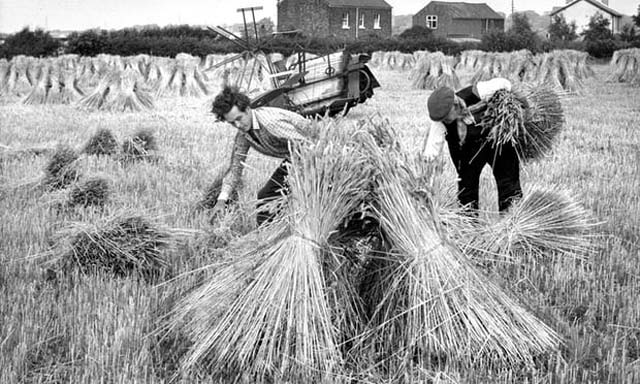
The wondrous fine days of last week have come just right for the harvesters. Although tractors with rack-reapers are not so picturesque as with horses, there remains a flavour of the sacred earth at harvest-time. The more especially in large fields with men and girls scattered at various jobs. And I have seen a young fellow, stripped to the waist, and as brown as a South Sea islander, with a girl beside him, her hair neatly plaited in pigtails, both holding on to a jolting bar, as they returned to the farm after work. The quality remains, in spite of the combustion engine. In many fields the straw is being trussed, and not wastefully burnt. Various uses are being found for it besides the bedding down of animals; in right conditions cabbages can be grown, also seed potatoes bedded and grown, with great saving of labour. If for no better use, it can be made into compost. The hot days have brought swarms of flying ants, fat, juicy, young queens, that birds relish. Starlings, that naturally have quick, gliding flight, learn to hover, not very well, but sufficiently slowly to snatch at the flying ants in mid-air. The starlings fly at a low level over fields and gardens, and, higher up, seagulls circle to taste the formic acid flavour.
Most of us are of the age to remember that scene some fifty years ago with fond memories. Life was generally unhurried, with those long hot happy holidays in August – and the catch-phrases of the time. They did well to get the harvest in on time.
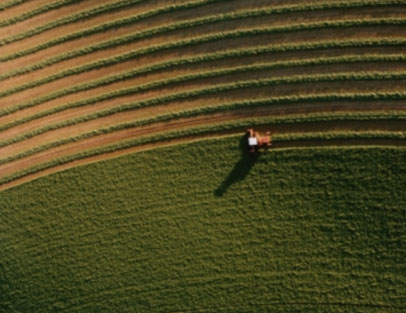
What can be described as a revolution in the processes of harvesting and storing grain crops since then was prompted by the introduction of a high-input system in the 1950s. This was based on the combine harvester, and it has remained the standard method of harvesting grain crops up to the present day. The ‘combine’ is a machine which reaps, threshes and partly winnows the crop in one pass – it combines three harvesting processes in one machine. The system also requires grain driers to be built on or near the farm which reduce the moisture content of the grain so that it can be kept in bulk storage facilities until required. The grain driers are only needed for the few weeks of the harvest
With the old air drying system the harvested crop was bound into sheaves, stacked upright in stooks or shocks and then air and sun dried in the harvest field. When the grain had dried sufficiently, the sheaves were carted and either stored under cover or built into a thatched rick. This method of storing crops offered flexibility in the timing of threshing, milling and marketing the products – the sheaves were threshed on the farm during the following autumn and winter as and when the grain was required for sale, milling or other purposes.
If you want efficiency in terms of cheap food you need the combine working in large expansive fields, but this is at the expense of the small farmer, the wildlife and the landscape – less hedges and no fallow fields. The agronomists have produced over the decades new dwarf strains which have increased yields dramatically, and crop rotations have been eliminated. Ashridge farmers have no doubt benefited from the extra income generated by these changes, in turn allowing landowners like the National Trust to set higher rentals.
We joined the Common Market in 1973 and the Common Agricultural Policy ( C A P) has sustained the farmer with guaranteed prices of production ever since, but what will BREXIT in 2019 produce – that is another story.

Thanks to the Guardian for a part contribution.

Posted in Uncategorized | 1 Comment

Country Diary – A Summer Breeze


This slideshow requires JavaScript.

A Country Diary 16th August 1917
A breeze which sets thistle-down flying across the lane shakes the wheat sheaves lightly; you can hear ever so slight a singing as it searches between the stooks and in the hollow of the straws. On this upland a waggon is at work and children are gleaning – leasing, as we call it here; – not so many of them, as years ago, for there is no water-mill by the river where a small sack could be ground after the corn had been beaten out in a corner of the barn. This season grain has ripened quickly, ears drop yellow in the sunshine; fowls disperse themselves far across the stubble, ducks wander in a long line dabbling their beaks in the hollows, a cock pheasant, his tail glittering as it sways in the breeze, leads two hens, and is approached easily; hares sit composedly in a clump of red clover on the edge of the field.
Along the bottom of the hill clusters of scarlet berries on the mountain ash hang above the lane so ripe that they crush in the-farm boy’s hand when, riding on the straw, he tears off a bunch or two. Fruit will be abundant on the hedges; hips are yellow and the haws show their first delicate red in the mild evening haze. The bramble, particularly the low-scrambling bushes which bear the bigger berries, is covered with bunches; acorns are yellowing along the brim of the cups upon the oaks. The wood is very still; except for stray butterflies, a few dark red peacocks on the verge among them, there is scarcely any sign of moving life, and no sound from the small birds. It is nearly all warm colour now, patches of pale purple in the dwarf thistles on the down.

A Country Diary 16th August 2017
A breeze which sets thistle-down drifting across the winter barley from Pitstone hill, lifts a large flock of meadow pipits from the down. The lonesome call of the quail can still be heard from the arable field. This season grain has ripened quickly, ears drop yellow in the sunshine ready for harvesting for the malting house. The large patches of wild marjoram attract butterflies looking for late nectar – small heath, small blue, meadow brown, tortoiseshell, and gatekeeper. A kaleidoscope of colour.
Along the bottom of the hill the winter wheat has been taken in, and the resulting straw bales wrapped and protected from the weather are scattered like dice waiting to be picked up. No gleaning for the past fifty years – the combines leave little residue and the windmill is silent from it’s grinding past. The monster machines make short work of the large fields as their dust clouds drift on the breeze, upsetting passing motorists.
There is scarcely any sign of moving life on the hill and no sounds from the small birds – the whinchat on the fence line and the wheatear sitting composedly on the ground waiting for nightfall to continue it’s migration.
Fruit will be abundant on the hedgerows by the car park. The rose hips show their first delicate red, while the elderberries are turning purple awaiting the foragers along with the black bunches of berries on the brambles. It is nearly all warm colours now, golden grasses intermixed with yellow trefoil and the purple thistles and marjoram, and the dainty blue harebell.

Posted in Uncategorized | Leave a comment

They are at it again!


This slideshow requires JavaScript.

The annual task for the volunteers to purge the ragwort from the Beacon hills before it sets seed and creates another generation, has taken place.
Ragwort makes fields of gold, and to walk in them feels far more transgressive than a bucolic stroll through wheat or barley. Unlike the pale, safe, beige of ripening cereal crops, the ragwort is as bold as brass. Unlike the slim pickings in the sterile acres of corn-fields, the ragwort swarms with life and is a haven for butterflies and bees.
The insects, and those creatures who feed on them, are harvesting a crop that is toxic to humans yet the antidote to the intensive agriculture that harms insects. This year, as in most years there is a lot of common ragwort about. Among the butterflies there are commas, red admirals, meadow browns, common blues, small heaths and large skippers, their flight a folding-unfolding origami in the air.
Cinnabar moth caterpillars, like items of lost games kit – a sock, a sleeve – in their wasp-stripe warnings of toxicity feed on ragwort leaves. A fantasia of hoverflies, robber flies, solitary bees, bumblebees and beetles feed on ragwort pollen and nectar.
A harvestman spider – a full-stop on improbably spindly legs – hunts ragwort visitors, as do the house martins swooping above. A flattened patch is evidence of a deer lay-up; and dusk will be batty with nocturnal tribes. There is more life in one acre of ragwort than a hundred in surrounding arable fields.
The common ragwort, Senecio jacobaea  is a dangerous daisy with more myths (or alternative truths) about it than you could imagine. It is poisonous to humans but you would need to eat plate-loads before you felt ill. It is poisonous to horses but they don’t like the taste anyway – but harmful if it gets into their hay feed. Anyway you don’t see many horses running free on the hills. It is harmful to the cattle but they only graze the hills in winter. Whilst there is legislation to control it, there is no requirement on landowners to remove it.
The flowers are golden and glorious, and despite, or maybe because of, its outlaw reputation as a pernicious weed, and our centuries of trying to root it out, the plant has an irrepressible spirit.
We have misjudged these heathens if we thought them repatriated to the heaths and commons of the past.
It is no easy task pulling ragwort. On our thin dry soils the roots run deep and unless the plant is removed completely, because it is perennial it will come again each year. The harvested plants then have to be burnt back at the stock yard after transportation – a lot of work which fortunately the volunteers enjoy.
So with all it’s merits why are we attacking it – why are we destroying a valuable habitat? Well it’s a trade-off with the more delicate wild flowers that we find in abundance on the hills – they need to be nurtured at the expense of the more aggressive types.

Thanks to Paul Evans for his contribution

Posted in Uncategorized | Leave a comment

Minority Groups


This slideshow requires JavaScript.

The National Trust are currently keen to highlight the achievements of minority groups at their properties, where they may well have suffered hostility. At Ashridge we can continue this theme with an expose of the Welsh legacy which runs deep in England. We can look at the landscape on the Estate and marvel at the hollow-ways carved out over the centuries by the Welsh, and be surprised at the adoption of place names like Piccadilly Hill for their gathering places, but there is more.
The Welsh had a trade presence in London in early Medieval times in the parish of All Hallows along the banks of the once bustling river Walbrook first mentioned in 1274, which takes its name from the Old English wala, meaning “of the Welsh,” and broc meaning “brook.” As early as 1312 some seven hundred cattle from North Wales were sent to Windsor for use in the King’s House-hold.
However In England, there was a mythological association of Wales with vagrancy dating back to the time of Owen Glyndwr in 1401 when an oppressive ordnance was passed providing inter alia that, “the minstrels, bards, rhymers, wasters and other vagabond Welsh in North Wales, be not suffered henceforth to over-run the country as has been done before; but let them be entirely forbidden on apin of a years imprisonment”.
Henry IV (1399-1413) maintained that the rebel Welsh among whom the spirit of freedom could not be quenched, declined to sit comfortably under the New English Order, and because they were “agein the gode purpos and commune profyte of the reiaulme”, they must be classed as vagabonds.
It was in the reign of Elizabeth I (1558-1603) some two hundred years later when registration was mandatory, that the Welsh cattle drover needed to carry his license with him to escape punishment at the stocks or pillory, as a vagrant. At this time Welsh drovers were travelling in increasing numbers into England without maps to guide them in an unfamiliar and hostile environment, so they embarked on a strategy of creating way-mark signs – using Scots pine trees.
Richard Mabey in his book Flora Britannica states that in the warm period which set in about 5,000 years ago pine trees were finally driven out from England and Wales by deciduous trees, and since then all Scots pines have been planted or have self-seeded from planted trees. That being the case one wonders when they were re-introduced and by whom.
John Evelyn in his book “Sylva” in 1664 stated “The worst land in Wales bears (as I am told) large pine”, so the Welsh have been credited with having returned the Scots pine into England from a relic outlier in North Wales, since the tree was not planted as an “ornamental” until the time of Capability Brown in the mid 1700’s.
The earliest record of planted trees in England is from 1669 at Wareton near Newport in Shropshire on a drover route going to the Midlands. The group of thirty five pine trees had measurements suggesting a planting in the early Tudor period.
The Scots pines were no doubt chosen as way-mark trees by the Welsh because they are evergreen, with a distinctive crown, surviving on poor soils, and are rarely browsed by cattle or deer, and were not to be seen in England. – their only limitation being their short lifespan of about two hundred years. Some pines can still be found at road junctions and water-holes, at river crossings and adjacent to public houses and farms where the Welsh would find a welcome – they were not universally popular. They had a reputation for being upright men but close- fisted, and in a group presented a formidable force in the countryside.
Here at Ashridge we still have a fine specimen of a way-mark tree deep in the wooded area of Ivinghoe Common. Planted some two hundred years ago adjacent to a derelict brick pit which would have been used as an overnight coral for the cattle, when the area was an open common. This is one of Bob Davis’s special trees featured in the current exhibition at the Visitor Centre – he was unaware of it’s existence until it was recorded for the Ancient Tree Hunt in 2011.
We are probably all aware of the “white horse” chalk hill figures and crosses scattered around the south of England. Many of them were cut in the 19th century as copycat figures of earlier times and some are ancient, but the majority have no known history. Unlike the chalk crosses at Bledlow (SP769009) and Whiteleaf (SP821039) in Buckinghamshire which can be seen today at a distance across the Vale of Aylesbury, but have no historical records, there are three archive records referring to a “white horse” hill figure at Ashridge, on Pitstone Hill. It has the same sight line as the crosses, and pre-dates 1580. This is a useful clue as to the age of the chalk crosses, because they no doubt served the same purpose, being way-mark signs cut by the Welsh cattle drovers in Tudor times, adjacent to known drover routes into London from Wales. The Welsh had the need and the manpower to keep the crosses regularly scoured, but the white horse figure at Pitstone fell into decline and is long gone.
We should thank the Welsh for the legacy which we have inherited – Diolch yn fawr iawn.

Posted in Flora and Fauna, History | 2 Comments

On the Move


This slideshow requires JavaScript.

One hundred years ago the men would have been walking the sheep to market, but here they are being returned to the field from which they escaped – the result of a careless walker leaving the gate open at Ward’s Hurst farm. (Ward’s comb in 1762)
This was the very route taken by the long distance drovers as long ago as Tudor times, walking their cattle from Wales to Smithfield market in London. This is confirmed by the hollow-ways skirting around Beacon Hill , to their meeting place at Piccadilly Hill – the cattle wore metal shoes which scoured out the track-ways over the centuries leading up over the escarpment.
Beacon Road was a mere track-way in those times, devoid of vehicular movement, until the Bridgewaters rebuilt it in the early 1800’s, but it would take another one hundred years before it became a modern tarmacked road. Like so many important discoveries in life tarmacadam came about by chance in Derbyshire in 1901, when a barrel of tar literally fell off the back of a “lorry”! It went on to become the world-wide method of road construction which today we take for granted. The much acclaimed painting by Paul Nash shows the road in 1924 still without a tarmac surface. The roadway as it passes Crawley Wood is at the highest point on the Ashridge Estate at eight hundred and sixteen feet (249 metres), sixty two feet higher than the Beacon, and may well have been a landmark in ancient times when the area was an open common and probably located on one of the original routes of the ancient Icknield Way.
The drovers took to using these secondary routes throughout England because of the ruinous state of the main roads. The upsurge of trade from the Tudor period produced lots of heavy haulage waggons that turned many road surfaces into a quagmire in winter, and a dust bowl in summer. The introduction of turnpike roads was very successful because they were maintained, but largely ignored by the drovers since they incurred toll charges!
Daniel Defoe in 1724-1726 said of turnpike roads that ‘The fat cattle will drive lighter and come to market with less toil and will go further in one day and not waste their flesh and heat and spoil themselves in wallowing through the mud and sloughs as is now the case.’ – between 1760 and 1774 some four hundred and fifty Turnpike Acts were passed.
So imagine the colourful procession with the shouts of a Welsh voice, the noise of the whips, the dogs and cattle, with their metal shoes, and the dust from the road – what a sight it must have been!
Life was very quiet in the countryside in those days, and the sounds would have travelled for miles. There was no mechanical noise to interfere with the sounds of nature apart from the occasional cart, and the distant ringing of the church bell for a birth or marriage, or tolling for death. Sunday was observed as the Lord’s day when all the country folk were called to Church, and the Welsh drovers took a rest day.
George III passed an act in 1774 restricting all road traffic on a Sunday.
In September 1869 The Reverend Mr Roberts, Secretary to the Scottish Sabbath Alliance, questioned why Scotch drovers moved their cattle on the Sabbath. “Now the Welsh drovers were far from being good men – some of them were pious – but there was such regard paid by them and everyone else to the religious feelings of the community, that not one of those wicked men would take it upon himself to drive cattle through the country on the Sabbath day”.

Posted in Uncategorized | 1 Comment