HAY THERE


This slideshow requires JavaScript.

Make hay while the sun shines is an old English proverb meaning to make good use of an opportunity while it lasts. Well the sun rays were very short lived last week for making hay in Meadleys meadow – the seventeen acre field behind the Visitor Centre cut for hay in July since 1315 at least. It was cut and got in, in a couple of days to make way for the arrival of the Big Camp weekend. Until one hundred years ago it was cut by hand and that would have taken a week or more depending on the weather. The Irish would arrive for the summer season with their trusty scythes, some thirty or more standing one behind the other in a diagonal line across the field, urging each other on wanting to claim their peace-work payments. What a sight and sound that must have been.
When Stubbs painted his “Haymakers” in 1785, now held by the Tate Gallery, the vast majority of the population lived in the countryside. Agricultural practices have changed beyond recognition but farming, as then is still governed by the seasons. Agricultural life was made up of long hours of slow repetitive labour, followed by evenings of long hours of companionable conversation, either in the cottage or at the ale-house. The only highlights during the year for the country folk were the religious holidays, and the annual fairs. There were no trips to the town shops, whilst the village or parish remained self supporting. Ideas and practices were very localised and new ideas spread slowly, but it must be remembered that the very existence of the village was to produce food. It is equally important to remember that the village was a human community that lived in association with itself, not as it is today. When visiting the area in 1748 Mr Kalm the famous Swedish botanist analysed the hay crop and identified twenty one sorts of plants in the haystack at Ashridge. He noticed that the Duke’s land had a number of hay boxes made of oak, fourteen foot square by eight feet high, with an adjustable thatched roof, on poles thirty feet high. These were to supply hay to the deer in winter. At that time hay was collected together and stacked in ricks, some of which were as large as a cottage, with a thatched covering. The hay was fed to the cows and horses in winter time. The later mechanisation of the cutting and collecting of the hay crop improved farming efficiency at the expense of the labourer, as today the hay coils are stacked in piles in the farm-yard protected in a plastic wrapper.
The 1785 painting depicts a bucolic scene showing the fashion of the time when Kalm noted that people always wore shoes despite the dirty conditions, unless they rode a horse, when they wore boots.. Everyone wore a wig called a peruque, from the youngest child to the farm labourer, along with the ubiquitous hat.
 

Posted in Events, Flora and Fauna, History | 1 Comment

AT BEACON HILL


beacon

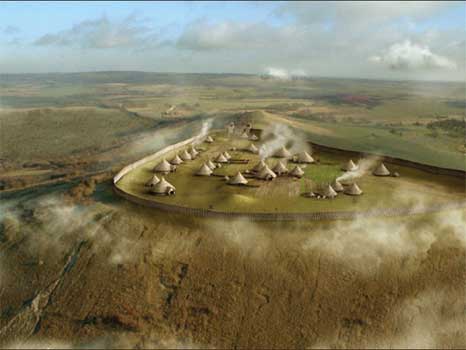
The old hill fort at Beacon Hill
Is a peaceful place today-
A place to potter, a place to rest
And dream an hour away!
Here I can drop the cloak of care
Which links me with the town;
While the sounds of sheep are wafted up
And lark songs trickle down.

Mistrustful stoat and fearless wren
Both watch me as I sit
Upon the turf near filled in shaft
Of neolithic pit,
And, by my side, where ragworts bloom,
And clumps of knapweed grow,
The rabbit scrapes point out the way
To old flint mines below.

Upon the loosened soil I spy
An ancient axe of flint;
A covering of white has now
Obscured it’s darker tint;
But otherwise ’tis hardly changed
Since first chipped out, although
It left the hand of Stone Age man
So many years ago.

The stone tool holds some curios charm,
And I rest again
I grip it’s butt, I close my eyes
And give my fancy rein.
It’s magic edge cleaves through the years,
And I can look at will
Into the days of ancient folk
Who worked upon the hill.

I see a craftsman shape a flint
And fit it in a haft;
I help to haul the packs of flint
Drawn up a deep mine shaft;
I revel in the sun and wind;
My limbs are strong and brown;
With axe in hand I tramp along
With men of the old chalk down.

But green woodpecker’s jeering laugh
Drives all these thoughts away,
And waning sunlight tells me that
I should no longer stay;
And though my axe will smooth the work
Tomorrow’s morn must spill
My steps are slow-I’m loath to go
Away from Beacon Hill

Credit to Barclay Wills in the 1920’s


Posted in Poems | Leave a comment

Snakes alive


This slideshow requires JavaScript.

The Trust needs information on the distribution and numbers of reptile species on
the Ashridge Estate to protect them effectively.
Earlier this year seven volunteers answered Emily Smith’s call to take part in a
Reptile Survey – Marion Adams, Tim Edwin, Barbara Hayman, David Humphreys,
Lorene Preston, Frances Read and Wendy Roscoe.
The team visit Prince’s Riding and Northchurch Common regularly to examine reptile
tins, log piles, fallen trees, etc. where reptiles may be found. Frances Read has
taken particular responsibility for Hudnall Common.
Reptiles are ectothermic. This means they require an external ‘boost’ to their body
temperature to become fully active. This can involve ‘basking’ on a heat gathering
surface in the sunshine (in the open or amongst some vegetation) or under objects
[refugia] that absorb heat.
Our refugia are Reptile Tins, which are rectangles of corrugated iron, tethered to a
marker post, which reptiles find an attractive spot to warm up. The tins attract the
sun’s heat more quickly than the surrounding ground and they need to be placed in a
sunny but hidden-away spot. Approximately 30 tins were placed before the growth of
the bracken and a GPS is needed to find some of them!
The volunteers approach quietly then gently lift the reptile tin to avoid disturbing any
wildlife taking shelter beneath. So far the team have observed and recorded grass
snakes and common lizards at various locations as well as common frogs and toads,
small mammals and insects. Sadly no slow worms have been seen yet. Written
reports and photographs are sent to Emily to add to her records.
Emily would welcome reports and photos of reptile sightings at other locations
around the Estate.

Thanks to David Humphreys for this contribution. 

Posted in Surveys | 1 Comment

As time goes by……..


This slideshow requires JavaScript.

Another week, another schedule of jobs to do at Ashridge. A five thousand acre estate produces endless tasks, so it was good to see a high turnout of volunteers last Thursday being given a varied selection of tasks – maintenance of the rights of way, along with signage installation, housekeeping in the greenhouse, and the removal of more alien plants.

There was also a ladies circle led by Pete recording wild flowers on Stepps Hill. Not the easiest of tasks when there is such a profusion of flowers this year – it’s rewarding to announce an abundance of something beautiful and appealing because of the maintenance regime on the hills.

Since 2012 the N T has been focusing on improving the quality of experience for the volunteers. They wish to involve volunteers in every aspect of their work, making sure that staff members are confident and able to work alongside us. They have just announced a considerable breakthrough in N T membership now topping five million so we can expect more visitors, although there is still work to do because the Visitor Enjoyment ratings remain “stubbornly below target”.

Ashridge are now planning to inspect all of the legal rights of way with a regular maintenance routine, involving the pruning and cutting back of encroaching vegetation. To this end all legal pathways on the Estate have been allocated a designated number to enable easy location, details of which can be found on the Zonal maps which can be accessed from the banner headline above. All car parks have been named, and new information boards are being erected at the busiest places giving local details and routes with “You are Here” identifiers so that visitors can find their bearings. The distinctive maroon livery has had to give way to a battleship grey house colour, but the iconic silver omega signs will be retained in most places.

Variegated mint might be favoured in a garden, being a strong growing attractive perennial but it soon gets out of hand forming an extensive colony, so we can find it dumped in the woods by a thoughtless gardener. Another alien plant to be dealt with by the volunteers!

Posted in Thursday Conservation Group | Leave a comment

Good-bye-ee


Good-bye-ee 

What can you say to someone who has been the life-blood of an organisation for years, when they leave unexpectedly?
Good-bye-ee! good-bye-ee!
Wipe the tear, baby dear, from your eye-ee.
Tho’ it’s hard to part we know,
You’ll be tickled to death to go.
Don’t cry-ee! don’t sigh-ee!
There’s a silver lining in the sky-ee.
Bonsoir old thing, cheerio! chin chin!
Nah-poo! Toodle-oo!
Good-bye-ee!

Always the welcoming face at the office door, his influence will linger long on the Ashridge landscape, where he has brought about significant change during his twenty seven years of service. 
Shy and retiring, hiding his light under a bushel he never has a sour moment neither in person nor on paper.
A country boy, generally laid back but with a “wild” side. Drives a pick-up truck and probably likes country music. Raised in the backwoods of Dunstable from where he explored the nearby countryside from an early age. A hard worker without taking things for granted. Masculine, but with a kind nature always treating people with respect. Ladies love country boys!
Old fashioned and conservative his like will not be seen again at Ashridge. The silver lining for us card- carrying countryphiles will be to bump into him on one of those Ashridge walks.
See the subject at home in his habitat.

Good-bye-ee from your Volunteers.

Posted in Events | 2 Comments

STEADY PROGRESS


This slideshow requires JavaScript.

Twenty volunteers gathered at the Visitor Centre last Friday to hear Ben N give a briefing on the new instructions and information being rolled out from the Estate Office. The Trust are pleased to now be able to implement certain updated core documents covering role responsibilities, Estate zonal maps, incident guidelines, through the workings of the Volunteer Rangers.

This engaged group of volunteers has brought about considerable progress with the on-site workings over the last year. They are now purveyors of information with the issue of three specific hand-out leaflets for the public, which are to be given out person-to-person when appropriate – when the visitor asks for information or is clearly not abiding by the rules of Ashridge.

The Trust has grasped the nettle and published some hard-hitting instructions for bikers, dog-walkers, and horse riders. This supports the more outward facing role of the Rangers when engaging with the visitors – a form of outreach. Up until now there has not been an easy way to disseminate detailed information to the visitors bearing in mind that over seventy five percent of them never enter the Visitor Centre. Now with the involvement of the Rangers the information will reach the public. Thirty years ago the Trust relied on fixed outside dispensers on Monument Green which became damaged with the literature ending up on the ground., so when the V C was erected in the late 1980’s the dispensers moved indoors.

After the briefing the group led by Emily, took a walk in the woods hoping to catch a glimpse of the holy grail of butterflies – all hail the Purple Emperor, the jewel of the wild-woods and the embodiment of summer. It is the second largest butterfly in the U K, and it’s devilish difficult to spot. Ashridge has the necessary habitat with it’s oak and sallow trees to attract this declining specie, so with some help from the Trust it may become a firm resident.


Posted in Events, Volunteer Rangers | 2 Comments

A Chequered Past


This slideshow requires JavaScript.

It is hard to imagine today that Kings and Queens and the aristocracy would have passed this way over the years. The Thursday volunteers have been working to restore the look of Old Copse Drive, in the shadow of the past – a once prestigious carriageway that is today in parts reminiscent of a swamp. It was created in 1813 when John William the 7th Earl of Bridgewater decided to build the road from Aldbury to give access to his new Mansion via Thunderdell Lane, and since then it has had a chequered history. Groundsmen working on the Estate in the 19th century would have had to defer to any passing dignitary, by doffing their caps!
On the 8th July 1889 the Shah of Persia and his Queen having spent the day at Ashridge, left for their next port of call at the Rothschilds at Halton by Tring, and would have no doubt used this carriageway along with their entourage. It would have been a showcase route lined with evergreen laurel and rhododendrons and specimen trees, with not a fallen branch or leaf in sight. One particular tree would have stood out as a talking point – the Wellingtonia pine from California introduced into England in 1854, still standing in the avenue. The other planted trees are unknown to us since they were stripped out by over zealous timber merchants between 1925 and 1930, after the N T had purchased the property but before it was actively managed. It was planned to replace the trees with an oak and beech avenue, but this seems not to have materialised . Instead an avenue of wild cherry (Gean) was planted and some still stand today, sixty feet tall and well past their sell by date – they were planted for their delicate white spring blossom and autumn colour. There have been strange additions of box and laburnum also planted over the years.
When Walter Rothschild wanted to pay a visit to his aristocratic neighbour at Ashridge he would no doubt ride over from Tring Park with his equipe zebra four-in-hand, thrusting along Old Copse Drive in the early 1900’s when the carriageway was at it’s zenith.
In the Summer of 1934 the newly arrived Trust “hoped to hold a tree-planting ceremony in the autumn, to inaugurate the re-planting of a new avenue of oak and beech along the Rhododendron Drive in Old Copse, and to re-open the once beautiful drive to the public”. The pretty lodge building and the distinctive gateway were probably created at that time. More recently a line of Swedish Whitebeam was planted along the drive and for some obscure reason they ended up being pollarded – why pollard a Sorbus intermedia? The Trust have now concluded that they look so ugly and out of place that they must be removed later in the year – more work for the volunteers.

Thanks to Richard for his contribution to the post.

Posted in Events, History, Thursday Conservation Group | 2 Comments

A Good Read


Ashridge R Macfarlane walksgood reada great read

Summer time and book reading seem to go hand in hand, like  Wimbledon and strawberries.
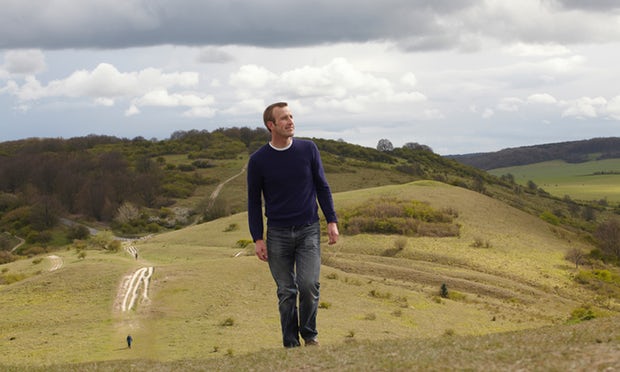
With his last book about Britain’s ancient pathways, author Robert Macfarlane completed a trilogy on his acclaimed meditation on landscape.

Finding a bad word to be say about his work is no easy task. The inside front cover of his paperback “The Old Ways” lists fifteen authors who made it one of their books of the year in 2012; the next four pages contain quotations from thirty five reviews, all saying essentially, “Read this book.” There comes a point when exhortation to do something proves counter-productive; and further on from that point, it becomes perverse not to do it.
So you might like to join the end of a long line of Macfarlane fans. He is part of what we are being told these days is a new generation of travel writers who create personalised accounts of some form of extreme, or at least interesting, geographical tour. Of course anywhere is interesting if you bring enough attention to it, and this kind of thing has been going on since Marco Polo’s stories were written up in the 13th century.
Macfarlane tends to prefer the wilder and woollier environments, like the Icknield Way. His second book,”The Wild Places”, tried to get as close to wilderness as these islands make possible; as did his first, “Mountains of the Mind”.
But here in “The Old Ways” unlike in “Mountains of the Mind”, Macfarlane is more interested in passes and paths than in summits. He has managed, as far as is possible to avoid repeating himself even as he revisits previous haunts. He describes this as “the third book in a loose trilogy about landscape and the human heart”, and that “loose” means it doesn’t matter which order you read them in, or if you only read one. This is really a book about walking – though there is a good deal, too, about the paths of the sea. It is illuminating to be told that before the Romans came, there was an extraordinary amount of sea traffic around the British Isles and Europe, which helps account for the remarkable genetic similarity of people from various coastal regions extending from Orkney to Spain. He helps us understand what it is to see the water as criss-crossed by routes as the land, partly by describing what it feels like to sleep in an open boat where the only navigational aid is the Pole Star.
There are also paths that are not paths: xenotopic places. He coins the word “xenotopia” to describe an uncanny landscape, and the part of the book that nails this concept best, and which will get you irrevocably hooked on his writing, is when he travels the Broomway, a contingent path along tidal sands between Wakering Stairs and Foulness in Essex, unearthly in both the literal and figurative senses, and said to be the most dangerous path in Britain. Reading the chapter will leave you with an impression of strangeness you will rarely, if ever, have encountered elsewhere. Writing and walking are great companions – think of Iain Sinclair, or Will Self. Here is a first-rate addition to the genre.

Credits to Nicholas Lezard, Rachel Cook and Andy Hall.

Posted in Flora and Fauna, Walks, Wildlife | Leave a comment

Summer Bounty


This slideshow requires JavaScript.

This was a “mindful”walk at it’s most intense – an important therapy for today’s stressful life. The walkers were blissfully unaware of their destination merely concentrating on the amazing flora and flora through which they travelled.

Unspoilt chalk downland is a rare and highly prized habitat which can produce an abundance of wild flowers and butterflies in favourable seasons. People maintain and complain that no corner of this right, tight little island has been unimpressed by the human boot – well this is as wild at it gets in this part of the world.

The gentle stroll last Monday took over two hours for the twenty or so visitors navigating the Ivinghoe Hills led by Lawrence , and supported by the stalwart volunteers, Anthea, Arthur, and Mike.

Flowers and butterflies have a symbiotic relationship – they depend upon each other for their survival with butterflies taking nectar and in turn pollinating the flowers. While bees do a lot of pollinating buzzing their way from flower to flower, butterflies glide and flit back and forth as if they know that they are putting on a show for us – some are territorial.

The profusion of wild flowers on show would be too numerous to mention. What was apparent was the amount of the yellow frothy blossomed Ladies Bedstraw, with it’s wonderful honey scent popping up all over the place. As the name suggests it really was used as a popular bedding for people in earlier times, with it’s springy quality and pleasant hay smell when dried. This reminds us that the country folk around Ashridge used wild flowers and plants not just for medicinal purposes but for practical ones, as well as food additives – summer was a bountiful time for foraging for the people when over eighty percent of the population lived in the countryside.

Apparently the hills at Ashridge were intensively grazed by sheep until the nineties, with many more animals than today grazing all year round. This denuded the slopes and it is only now with a change in farming policy that a more acceptable sward has returned to support the flowers and thence the butterflies. The return of clumps of brambles is an important requirement for the summer warblers and the local rabbits as well as the scarce large dark green fritillary. The silver washed fritillary occupies the wooded slopes of Steps Hill where the oak tree is present. It is a fast moving butterfly of the woodland glades feeding off the flowering brambles. Interestingly it lays it’s eggs in the bark of the oak tree where they over-winter before emerging as grubs in the Spring to descend to the woodland floor to feed off the dog violet, and then to emerge as a butterfly a few months later.

If you have not yet experienced the joys of chalk-hill walking in high Summer then you can join the Rangers next Saturday , July 1st from 10am to 12noon at the Beacon car park for a mindful event.

Posted in Uncategorized | Leave a comment

Pick-and-Mix again!


The packed program of special events continues through the Summer at Ashridge – the following list will help you when organising your volunteering time-table for the next two months. There are at least eight events to consider – either join the event as a visitor, or volunteer to help, by contacting helpingashridge@nationaltrust.org to register your interest.

Saturday 1st July Wild Flower Walk 10.00am-12pm
Join the Rangers on the Ivinghoe Hills to learn about this habitat.

Friday 7th July Volunteer Rangers Forum 10am-12pm
Ben will run an induction first (9am-10am) on his maps and role guidelines.
Bat Walk 8.30pm – 10pm Look out for bats.
Friday 14th July Lawrence’s Send – off Party 6pm to whenever
Arrive early at Meadley’s meadow to get the best of what’s on offer.

Saturday 22nd – Sunday 23rd July Big Camp overnight event
Take part in a number of family activities including a candle-lit walk.

Mondays & Wednesdays in July and August Ashridge Adventurers
10.30am – 12pm or 1pm – 2.30pm
Join for the crafty sessions on animals and plants.

Friday 4th August Creatures of the Night 8.30pm – 11pm
Join the Rangers to hear about the nocturnal creatures at Ashridge.

Tuesday 8th August Gentle Stroll 2.30pm – 4.30pm
Start at Steps Hill car park taking in the delights of the summer butterflies.

Saturday 12th August – Sunday 13th August Big Camp overnight event
A repeat of the July event.

Sunday 27th August The Dovecote 11.00am – 2pm
Look back in time to the 18th century in Aldbury.

Watch this space for more appealing activities throughout the year.

Posted in Uncategorized | Leave a comment