
 An ongoing task. If you come across any fly tipping reply to this post and we will contact the estate office.
The majority of litter is found in and around the car parks usually after a weekend or an event.
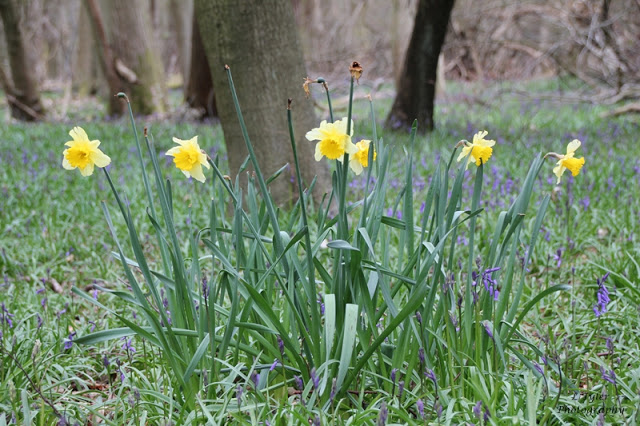 The Thursday group is currently digging up all the non native daffodils which shouldn’t have been planted.
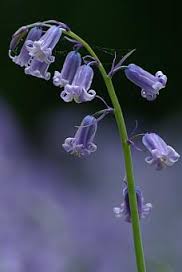 Originally Dockey Wood was part of the extensive Ivinghoe common running down to the village of Ringshall, in Tudor times. The common was an open grassland with gorse and scrub predominating. There was probably a copse of trees at this spot which was added to by the Bridgewaters when they purchased the land in the 1600’s, making it an ancient woodland. They no doubt planted oak trees as a commercial crop for local building or the ship trade. The bluebell wood is shown on the 1762 Estate map when it was smaller than today. The road to Ringshall was not built until the early 1800’s, before which it was a mere cart track at the edge of the common, going to Ward’s Comb and onto Dunstable. The trees were felled over the centuries and replanted. The latest oak trees were planted some fifty years ago and would be thinned out in due course – the normal arrangement for a plantation. In April 2016 Dockey Wood became nationally famous for being the first National Trust property to introduce a charge to view the bluebells, and the resulting media interest was considerable. Every year many hundreds of people would visit the site each day – visitors travelled from as far afield as Canada and Lichtenstein – and the small wood became over crowded, and damage was caused to the plants. The flowering of the bluebells creates a carpet like effect with a dense blue haze, which combined with a delicate fragrance creates a heavenly experience. To create the perfect picture all of the undergrowth and fallen debris was removed to give a sanitised result – not normally the case with the natural wildness of the Ashridge estate. The name Dockey is likely to be a corruption of the word donkey. The long distance pack train trade in Tudor times used donkeys or mules on regular routes to transport letters and goods into London. The convoy would consist of some twenty animals with two drivers, and the wood was no doubt used as an overnight stopping place for the men and donkeys. Place names were given by the local people and were descriptive of the place. Another name for an overnight stance was Coldharbour.
-
Join 67 other subscribers
February 2026 M T W T F S S 1 2 3 4 5 6 7 8 9 10 11 12 13 14 15 16 17 18 19 20 21 22 23 24 25 26 27 28 Categories
Top Posts & Pages
Archives
- September 2020 (2)
- August 2020 (1)
- July 2020 (2)
- June 2020 (2)
- May 2020 (2)
- April 2020 (2)
- March 2020 (2)
- February 2020 (2)
- January 2020 (2)
- December 2019 (2)
- November 2019 (2)
- October 2019 (2)
- September 2019 (2)
- August 2019 (2)
- July 2019 (2)
- June 2019 (3)
- May 2019 (3)
- April 2019 (2)
- March 2019 (2)
- February 2019 (3)
- January 2019 (3)
- December 2018 (3)
- November 2018 (3)
- October 2018 (3)
- September 2018 (4)
- August 2018 (1)
- July 2018 (4)
- June 2018 (4)
- May 2018 (4)
- April 2018 (5)
- March 2018 (5)
- February 2018 (5)
- January 2018 (5)
- December 2017 (5)
- November 2017 (5)
- October 2017 (7)
- September 2017 (5)
- August 2017 (7)
- July 2017 (7)
- June 2017 (7)
- May 2017 (7)
- April 2017 (7)
- March 2017 (8)
- February 2017 (8)
- January 2017 (10)
- December 2016 (11)
- November 2016 (14)
- October 2016 (14)
- September 2016 (10)
- August 2016 (14)
- July 2016 (19)
- June 2016 (31)
- May 2016 (6)
Recent Comments
ashridgevolunteersbl… on SHEER JOY… Anonymous on SHEER JOY… Richard Gwilt on WELL-BEING… ashridgevolunteersbl… on What’s going on?… Anonymous on What’s going on?… Ashridge Volunteers hits
- 30,103 hits


 Ashridge Volunteers