BAD AIR DAYS


This slideshow requires JavaScript.

We often think of ozone as a stratosphere pollutant, where it does a useful job blocking out harmful ultraviolet radiation, but it is harmful to breathe, damages our crops, and is now thought to be behind the collapse in the insect population. In a typical May, UK air pollution can reach between four and six on the government’s 10-point scale for a week or so. This May if you remember was hot – the hottest since records began in 1919. This brought air pollution problems to the whole of England and Wales. Air pollution reached level 4 or above on 30 days during the month and ozone was one of the main culprits. In Europe we can lose up to 12% of wheat yields to ozone each year, but the impact is worst in the poorest parts of the world.
With no global agreement to control the pollutants that form ozone at ground level, –  mainly from vehicle exhausts releasing nitrogen oxides into the atmosphere which react with sunlight – this problem will only get worse. The race is on to find crop varieties that are better able to resist this air pollutant.

The insect custodian at the Berlin Natural History Museum, says he is worried that “the decline in insect populations is gradual and that there’s a risk we will only really take notice once it is too late.” 

It seems that there is an air of complacency pervading the planet

Canadian biologists in 2010, suggested that bird species that depend on aerial insects for feeding themselves and their offspring have suffered much more pronounced declines in recent years than other perching birds that largely feed on seeds. British birds like spotted flycatcher, tree pipit, wagtails or wren fall into this category.
So far, only the decline of honeybee populations has received widespread public attention, in large measure because of their vital role in pollinating food crops. The rest of the insect world has been widely ignored. Often insects are perceived as a nuisance or merely as potential pests but scientists emphasize the ecological importance of diverse and abundant insect populations for the food chain.

Until recently pesticides have been considered as the prime suspect for insect losses. However hill farmers in Wales who have no need for chemicals report a decline in butterfly and insect numbers despite a favourable floral habitat so there must be an invasion of pollutants – waves of ozone created in the urban and industrial areas. To understand the problem better, scientists are now urging increased monitoring efforts. A recent increase of monitoring efforts stems from the rise of “citizen science” projects, where lay people with an interest in the outdoors are trained to collect data. Closer to home volunteers could monitor the insect population in the Ashridge woods.
Currently if you took a quick look into the leaf litter beneath oak or beech you would be hard-pressed to find any insects – no spiders to speak of, the occasional snail or worm, a single woodlouse or millipede. Not much to show despite years of conservation with decaying piles of brushwood everywhere! Beware of any fungi and look out for the ozone!

Posted in Uncategorized | Leave a comment

Update


This slideshow requires JavaScript.

Last February the volunteers helped the Trust dead-head some saplings in Frithsden Beeches.

Pollarding is a pruning practice which removes the upper part of a tree promoting a dense head of foliage and branches. It has been common since medieval times and maintains trees at a predetermined height, above the reach of browsing cattle and deer. Wood pollarding tends to produce upright poles, ideal for fences, and posts, with some of the new growth used as fodder for livestock.

Clumps of young beech trees less than ten years old were singled out for treatment. With only a handful of the ancient beech pollards left in the wood , restoration work was overdue.

If you go down to the wood today you can now see the results. For a sapling it is a shock to the system to have its head removed – out of the fifty or so saplings that were pollarded more than half have survived so far. It will only need one or two trees in a clump to get-away and become ancient pollards in time – providing the squirrels leave them alone – they strip the bark in spring when food is scarce.

This is probably the first time in over a hundred years that new pollards have been created at Frithsden, or the existing pollards harvested.

The old “Queen” of pollards at Frithsden, the Harry Potter tree perished in a summer storm in June 2014. and the remainder may follow soon, so there is much more work to be done.

Posted in Uncategorized | Leave a comment

Unwelcome Visitors!


incombe

The National Trust slogan “for ever and for everyone” is a recent proclamation and would have been sorely tested on a May day in 1996 when thousands of visitors arrived at Ashridge.

The night the ravers came to Arcadia.

This article by Gareth Huw Davies was first published by The Daily Telegraph, May 1996.

One Saturday afternoon in Spring 1996. A forecast of rare promise. Dry with light southerly winds, 12C overnight, rising to the low 20s on Sunday. At Exodus headquarters, somewhere deep in Bedfordshire, High Command gave the order. Incombe Hole was on. By midnight a fleet of 12 ex-army trucks and Land Rovers, carrying enough audio equipment to rouse a small town, was trundling through the streets of Luton, leading, Pied Piperesque, a procession of 200 or more cars. Ten miles to the west farmer David Leach slept peacefully. Plain clothes police officers on a watching brief in the convoy had no real clue where it was heading. For the police to predict precisely where a rave will strike is akin to the Florida Met Office anticipating the landfall of the next hurricane.
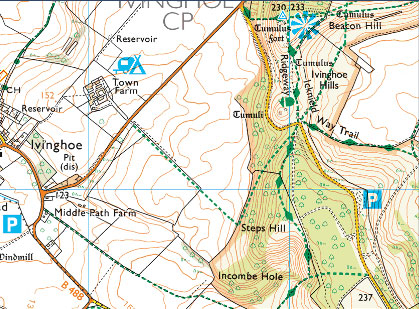
Past experience suggested they would chose one of eight locations in or around Luton. Then, unexpectedly, the swelling convoy veered west, rolled through Dunstable and crossed into Buckinghamshire. At about 1.30 am the lead vehicles left the road just below Ivinghoe Beacon, bounced across two grazing fields and entered one of the deepest, quietest folds in the Chilterns. Incombe Hole is a precious place, laden with plaudits. It is in an area of outstanding natural beauty, within the National Trust’s Ashridge Estate, and part of a site of special scientific interest, one of the few surviving shreds of severely depleted chalk downland. There are few places in Southern Britain more favoured by official designation and less suited to invasion by the heavy freight of a mobile disco and 8000 exuberant dancing feet. Yet Incombe’s celebrity counted for nothing. It was simply overwhelmed by a massive force of people determined to have fun. For all the promise of robust new laws on trespass passed in 1994, nowhere in rural Britain, outside royal estates and Ministry of Defence land, would seem to be immune from lightning strike by unannounced, boldly-executed rave. By the time David Leach woke at nearby Town Farm around 6am, the rave had been underway for four hours. 600 or so cars had traversed one of his fields and were parked on a grass ley he tends on behalf of the National Trust, while 4000 energetic youngsters caroused into the warm morning in the steep-sided valley. All other considerations aside, Incombe Hole is an ideal location for a noisy party. Leach, his senses fine-tuned to alien sounds in his countryside, had heard nothing. In any event, he could have done nothing. The battle was lost well before breakfast. Faced with a massive and unexpected incursion out of a neighbouring county, Thames Valley Police were forced to capitulate. Inspector Richard Maskell estimates it would have required weeks of planning and hundreds of officers – more than were on duty in the three counties covered by the force that night – to break up the rave, once it had started. The only option was damage limitation. For the rest of the day Leach and National Trust staff stood on the road turning cars away.
During the morning the farmer paid a single visit to Incombe, where he is the trust’s “preferred grazier” – he runs his sheep only after the delicate downland plants have set seed. “The young people were as high as kites. The organisers were initially pretty aggressive. I was very humble. I asked them when they were going. They said they would leave when it was all over.
“They had answers for everything. When I told them they were on an SSSI, one of the few sites for the rare pasque flower, they said Newbury was an SSSI, and look what happened there. They were quite contemptuous. They said they were not worried about me or the law because they moved in such big numbers there was nothing the police could do.”
Leach was handed a leaflet, defiant and self justifying in tone. Exodus, described itself as “a community sound system” fulfilling a useful social purpose, clearing the towns of bored young people. “We would much prefer to agree our dance venues. but as the law stands you would be liable to prosecution even if you gave us permission.” They promised to leave the land as they found it and repair any damage. They finally left early on Sunday evening, largely keeping their promise. Leach estimates they removed about 98 per cent of the rubbish. Visible damage was confined to two fires and a heavily trampled square of grass. Sheep loose in the field where cars parked were unharmed and were back grazing the ley within two weeks. However English Nature said it was too early to detect possible damage to the site’s delicate flora. (More by luck than judgement the rave appears to have missed the pasque flowers altogether.) English Nature’s predicament is that, while it can take legal action to stop a landowner damaging an SSSI, it is usually powerless against damage by third parties. The farmer could, in theory, with the help of a fast moving solicitor, have sought an injunction while the rave was underway, although serving it on a named individual among 30 pseudonymous organisers might have been difficult.
After the Incombe rave the National Trust dug a trench at the entrance to its land deep enough to exclude a car, but not a tractor, or an ex-military vehicle. Will it be sufficient to deter a repeat visit from Exodus, who pledge to hold fortnightly raves throughout the summer? David Leach isn’t sure. “They said they would be back. They told me they liked the venue.”

Copyright Notice. Copyright held by Gareth Huw Davies. Use for commercial purposes prohibited without prior written permission from the copyright holder. This text has been placed here as a facility for Internet users and downloading is permitted for the purposes of private, non-commercial research. The text must not be modified, nor this copyright notice removed.

Posted in Uncategorized | Leave a comment

Precious Plants


This slideshow requires JavaScript.

Ashridge should boast about their special plants like the fleawort, or the pasque flower, the green hellebore or the orchids for they need special conditions and protection for growing success. The conservation code kicks in when the Trust need to protect these special plants as in the case of the Violate Helleborine.
This rare orchid is a woodland dweller growing beneath oak or beech, appearing in the summer and flowering in August and September, with each plant displaying an amazing number of tiny orchid-like flowers in delicate shades of pink and green.   During September and October the brown seed pods ripen and split open revealing very fine seeds, similar to grains of dust which are wind-blown. Each plant produces vast numbers of seeds since the chance of one getting infected by the correct mycorrhizal soil fungus on landing, and thus being able to germinate, is vanishingly small.
The plant is pollinated by the local wasps which are attracted by the nectar in the cup-shaped part of the lower petal which almost has a narcotic effect, as they are so overcome that they they often fall to the ground in a drunken stupor.
Violate Helleborine is a fickle flower, not very conspicuous, often appearing unexpectedly in new locations. It takes many years for orchid seed to produce a flowering plant. Even after germination, it is usually several years before the first leaf appears above ground.  Curiously, most British orchids cannot germinate unless the seed is invaded by a particular soil-borne fungus, and the two then live in symbiosis with the fungus providing nutrients to the orchid.  This means that the orchid pseudobulb and its roots under the ground can develop, initially without the need for leaves and photosynthesis.
This variety of orchid is often located in road-side verges or close to pathways which is extraordinary. They therefore run the risk of being destroyed by car parking, or late grass cutting , but the real enemy is the deer population, particularly the small muntjac. Volunteer -made protection guards are therefore positioned over the plants so that they can fulfil their life cycle – aliens have landed in Harding’s Rookery!
Rare plants often attract unwelcome attention but plant hunters are wasting their time trying to collect Violate Helloborine because they are impossible to move successfully – translocation even with an intact root ball always ends in failure. Moving orchids is in effect a death warrant for the plant and is illegal. Wild flowers should remain in their wild situation and garden plants likewise, for moving them becomes in effect an act of gardening, which has no place at Ashridge.

Posted in Uncategorized | Leave a comment

Waspish !


This slideshow requires JavaScript.

Summer has gone, the wild flowers are finished so no more buzzing around the Beacon for the beneficial insects. The honey bees have flown home to the safety of their warm hives, while the worker wasps have all died in harness as unsung heroes.
We have to feel sorry for the wasps – they get a bad press although they only live for a few weeks in late Summer and are worked to death, while bees can live for many months. We love bees but hate wasps – why is this?
A new world-wide study published in Ecological Entomology reveals the plight of the wasp – they are largely disliked by the public, whereas bees are highly appreciated. No surprises there then. The researchers involved say that this view is unfair because wasps are just as ecologically useful as bees. The scientists suggest a public relations campaign to restore the wasps’ battered image. They would like to see the same efforts made to conserve wasps as there are currently for bees.
Wasps pollinate plants like bees, and take out harmful insects so are just as important in the environment but we despise them as if they are the sharks of the of the insect world. We all know that they punch a nasty sting if provoked, but so do bees. They may be deemed waspish but so are we all at times –
irritable, touchy, testy, irascible, cross, snappish, angry – so why do we hate the wasp so much that when they start building their home in an out of the way place like a  shed or in the loft we immediately call in the pest controller to eradicate them. Why not just leave them alone to do their thing – they do not regularly return to the same spot in following years. We feed the wild birds to help them through the colder days so why not feed the wasps in Autumn with jam for the sugars to help them live longer. We no doubt selfishly prefer bees because they produce something of a direct benefit for us – honey.
Next year let us tolerate and encourage our wasps – apparently they are not as irritable or as touchy as their continental cousins, and we will be leaving the E U in March 2019!

Posted in Uncategorized | 3 Comments

Take your pick!


pick 7 mix

The packed program of special events continues through the Autumn and Winter at Ashridge – The following list will help you when organising your volunteering time-table for the next four months. There are at least fourteen events to consider – one less than last year – dogs are in, but horses are out! There is a Watercolour Workshop on offer for painterly people while a WW1 Beacon of Light celebration should draw the crowds. 

Details of all charges and bookings must be obtained from the Ashridge Visitor Centre before an event.

Sunday 2nd September Walkies! 10.00am-12pm
Demonstrations, training and advice on your dog.

Sunday 2nd September Volunteer Open Day 10.00am-3pm
Volunteering opportunities at Ashridge.

Tuesday 11th September Golden Valley Stroll 10 30am-12 30pm
Join the volunteers for a walk in the footsteps of Capability Brown.

Saturday 6th October Ashridge In Autumn Walk 10am – 2pm
A volunteer-led guided walk.

Wednesday 17th October Deer Rut Walk – Gentle Stroll 10.30am – 12.30pm
Join the rangers to search for deer.

Friday 19th Saturday 20th Sunday 21st Friday 26th Saturday 27th Sunday 28th October Deer Rut Walk 7am – 9am
Join the rangers for an early morning walk to search for deer.

Monday 22nd to Friday 26th October A Halloween Trail 10am – 4pm
Spooky crafts at the Visitor Centre all week.

Sunday 28th and Tuesday 30th October Watercolour Workshops  1- 4pm Create your own watercolour of Ashridge.

Saturday 10th and Sunday 11th November  WW1 Beacons of Light 10am – 4pm
Celebrating the end of the First World War at the Beacon.

Saturday & Sunday 1st 2nd 8th 9th 15th 16th 22nd 23rd 29th 30th & Wednesday 26th Thursday 27th Friday 28 th December Childrens Christmas Trail 10am – 3pm
Follow the creatures of Ashridge on the trail and collect a gift.

Monday 3rd December to Monday 7th January Christmas Pudding Walk 10am – 4pm
A self-led walk through the woods.

Monday 10th Wednesday 12th and Monday 17th Wreath-making Workshops 1pm – 3.30pm
Christmas decorations created from the Estate’s greenery

Sunday 9th December Santa Paws Walk 11am – 12pm
Bring your dog for a festive walk.

Thursday 27th December Post- Christmas Walk 10am – 12pm
Enjoy a scenic walk through the Estate.

Posted in Uncategorized | 1 Comment

Pennies from Heaven


This slideshow requires JavaScript.

Forty  years ago in 1978 George Lucas became the creative myth of today’s Hollywood, at a time when the Ashridge Visitor Centre was run solely by the volunteers!

Star Wars the movie – a scrappy little underdog of a sci-fi picture made for a paltry $11 million became such a box-office smash changing the entire business at the stroke of a fizzing light-saber.

Since then like the National Trust , Star Wars has attracted a large fan base and income and expenditure have grown exponentially – costs run to well over $200 million and income regularly exceeds $1000 million.

The next episode of Star Wars arrived at Ashridge from a galaxy far far away, for a three week stay in August with a two day grass shoot on the hills. Arriving with a huge entourage and elaborate equipment, extensive areas were prepared for parking, footpaths and car parks closed to allow for uninterrupted filming and the location of the open air shoot kept under wraps to avoid a flood of public sightseers.

Episode IX features an all star cast of eighteen including Richard E Grant, a posthumous Carrie Fisher and Matt Smith from Doctor Who. The indoor sets will be filmed at Pinewood Studios and Cardington Airship Sheds, with the big-budget film planned for release in December 2019 by Lucas Films for Walt Disney Pictures. The cost of the shooting at Ashridge is said to be in the region of £2 million.

Ashridge is such a fortunate location for such an epic production being close to London, offering extensive parking for the vast array of equipment and vehicles – ten mobile homes for the actors, some one hundred cars, numerous goods vehicles, catering and security, with lighting, generators, and 4×4 off road vehicles, not to mention the “extras”.

Today’s film crews are a common sight at Ashridge, and the Executive Producer was not to know that King Richard III and his band of brothers used the very same pathway four years earlier for a BBC production! A far cry from those early days when Ashridge was a back water with the tea-room and shop run by Margaret Cleaver and her dedicated band of volunteers. As with any “brand”, Star Wars and the National Trust need to be constantly refreshed with new developments and events to satisfy the fan base , while characters come and go.

Here on Earth the Trust’s aim of quiet enjoyment and solitude on the Estate was returned at the end of August when the last vehicle departed the stage leaving the SSSI site without any permanent damage – in fact leaving an improvement to the Coombe entrance with a long awaited new chalk overlay filling to the deeply rutted track-way.

Despite every effort by the organisers to respect the pristine landscape and return it to its SSSI status, litter escapes and hangs around for the final end game – enter the volunteers.

Posted in Uncategorized | 3 Comments

Dangerous Daisy


This slideshow requires JavaScript.

The ragwort, a really beautiful weed, has been shining out on the hills but, perhaps thanks to the volunteer’s labour, it was not over-abundant as in earlier years.
Ragwort makes the hills glint o’ gold, and to walk there feels far more inviting than a bucolic stroll through wheat or barley. Unlike the pale, safe, beige of the adjacent ripening cereal crops, the ragwort is bold as brass. Unlike the slim pickings in the arable fields the ragwort swarms with life. The insects, and those creatures who feed on it, are harvesting a crop that is toxic to humans yet the antidote to the nearby intensive agriculture that harms insects. So why are we destroying ragwort?
Ragwort is seen as a sign of bad behaviour – it’s what happens when we stop tidying up the place. It is harmful to horses and cattle, but only when it gets into their fodder – they avoid its bitter taste in the pasture. The reason that it is pulled from the hills is simply to prevent it taking over and shading out the more delicate summer flowers.
The annual August volunteer’s bash, toiling in the sun only contains the spread of this pernicious perennial – the root must be completely removed to have any chance of eradication and this is nigh on impossible in summer drought conditions. The best bet is to to remove the flower heads with secateurs and bin them to prevent seeding, then return in the Autumn to pull the plant roots and all. Best to cover up and wear gloves to avoid skin rash when handling the plant.
This year, and it felt sudden, the ragwort has been alive with invertebrates. Among the feeders there were commas, red admirals, meadow browns, common blues, gatekeepers, and small heaths, their flight a folding-unfolding origami in the air.
Cinnabar moth caterpillars, like items of lost games kit – a sock, a sleeve – in wasp-stripe warnings of toxicity fed on ragwort leaves. A fantasia of hover flies, robber flies, solitary bees, bumblebees and beetles fed on ragwort pollen and nectar.
A harvest-man spider – a full-stop on improbably spindly legs – hunted ragwort visitors, as did the house martins swooping above. A flattened patch is evidence of a deer lay-up; and dusk would be batty with nocturnal tribes. There is more life in one acre of ragwort than a hundred in the surrounding arable fields.
The common ragwort  Senecio jacobaea is a member of the daisy family – it is not dangerous when shown respect. The flowers are golden and glorious, and despite, or maybe because of its outlaw reputation as a pernicious weed, and our centuries of trying to root it out, the plant has an irrepressible spirit defying the Ragwort Control Act of 2003. The hills are extensive so why do we not leave a patch where daisy can thrive without hindrance as nature intended ?

The volunteers will be back next year!


Thanks to Thomas Coward

Posted in Uncategorized | Leave a comment

Cheers Ed….


The Editor is away on holiday!


Posted in Uncategorized | Leave a comment

Our Holloways


This slideshow requires JavaScript.

Holloways are a common feature of the Chiltern landscape, cutting into the chalk escarpment as they rise up to the plateau from the Aylesbury Vale. The volunteers are familiar with the pathways around the Beacon skirting Piccadilly Hill, in use until the road arrived around 1830 – they are regularly to be seen clearing out the scrub to keep them open for the wild flowers to bloom in profusion.
The oldest holloways date back to the Iron Age. None are younger than three hundred years old – some of them more ravines than roads. They began as ways to markets , to the sea, or sites of pilgrimage.
Holloways are part of England’s ancient arteries but are not marked on maps as legal rights of way. Used by pack trains, travellers, pilgrims, livestock and farmers, church goers, coffin bearers and as boundary markers, they are landmarks that speak of habit rather than suddenness. Like creases in the hand or the wear on the stone step of a doorway, they are the result of repeated human actions that no longer connect place to place or person to person.
The Ashridge drove-ways as the name implies were for the movement of livestock – particularly cattle. Drovers moving herds from Wales to the markets and fairs of southern England over the centuries, or Francis the 3rd Duke of Bridgewater sending his cattle from Worsley to Ashridge in the 1700’s – they all wore metal shoes for the journey which scoured out the drove- ways. This is not widely understood as Natural England are still informing the public on their notice boards that the holloways were created by the passage of sheep.
Further south on Duncombe Terrace and Old Copse drive the holloways are steeper, deeper and overgrown. The deep-set pathways too narrow for carts, with their duvets of tree foliage have lain untouched for a century or more – last used by the drovers and locals one hundred and fifty years ago. These leafy cocoons of country paths so engraved by centuries of footfall have become part of the forgotten skeleton of the countryside – like waterless streams cut into the chalk.
There was talk of clearing out the holloways around Aldbury and returning them to their former state as open common land. Although there are now more trees growing in England than for centuries, removing healthy trees is a cardinal sin – the villagers turned down the idea. Restored open holloways have a micro climate offering a rich habitat for flora and fauna, rather than the sterile woodland floor covering of the overgrown pathways.
Few holloways are in use now – they are too narrow and slow to suit modern travel, too deep to be filled in and farmed over. They exist – but cryptically. They have thrown up their own defences and disguises, nettles and briars guard their entrances, and the trees have taken over.

Thanks to Robert Macfarlane for his contribution.

Posted in Uncategorized | 1 Comment