We seek the collaboration of the various volunteering groups at Ashridge, to record their work experience, and showcase the restoration work which is achieved. When reporting events we aim to be topical and informative about environmental issues as and when they might affect Ashridge, and to provide background information on the plants and wildlife. There is no direct or implied connection betweeen this Blog and the National Trust. The Blog does not seek any commercial gain.
The Thursday group were back in action at the Beacon this week, removing the brash from the scrub clearance on the hillside. The steep slope created a hazardous working environment which meant that some volunteers worked back at the car park clearing the verges. The brash was bagged up and taken back to the Estate Office by the Trust for burning.
This iconic spot in the Chiltern Hills has seen much social activity in the last one hundred years. It became a tourist attraction when first visited by cyclists and car owners in the 1920’s. It became a must-see landmark when it was painted by Paul Nash in 1929, following a national preoccupation with pre-history which had been growing since Victorian times.
Clearing the scrub is not only a good thing for the flora, but it helps the thermal air currents to develop, beloved by today’s glider pilots. The warmth from the chalk slope lifts the air as a thermal, and the steep slope creates ridge lift from the prevailing wind. Today’s gliders are model planes but back in 1930 it was the real thing which graced the skies around the hill.
In 1929, a luncheon party was organised in London and the people attending formed the British Gliding Association. Out of this, a club for the London area was created and the London Gliding Club was inaugurated in February 1930. By this time, two or three very basic gliders had been constructed, and a search for a hilltop site to launch from resulted in the Club setting up at Down Farm on the Ivinghoe to Aldbury road, but after a month it was asked to move, on the grounds that the noise was disturbing the birds on the Ashridge Estate. By the middle of May, the Club had secured the use of Ivinghoe Beacon and enthusiasm was intense. An instructional week was organised with a charge of £2.10.0 covering the training, along with tented accommodation. By now, there were five single seats and one two-seat gliders being used. A competition was set up between the London Club and the Lancashire Aero Club, the aggregate times of alternate launches being logged. The contest came to a halt when the Lancashire glider landed in the tops of the pine trees at the foot of the Beacon. London Gliding Club had totalled 12 minutes 52 seconds and the Lancastrians 8 minutes 5 seconds.
A demonstration by the German ace Robert Kronfeld with his beautiful ‘Wein’ glider in the July attracted a visit from the Prince of Wales. All this activity brought crowds of onlookers, with the LMS Railway running excursions to Tring from Euston. When local roads became blocked by cars, the police forced the Club to move on. Too many visitors at Ashridge is not a new phenomenon!
The income from farming which the Trust collects from the tenant farmers, sustains the upkeep of the rest of the Estate. When Francis the 3rd Duke controlled the Estate (1748-1803), he was more concerned about his industrial interests in Lancashire – coal and canals. This led to the decline of the Ashridge estate which he left to run itself. Against all the odds , his industrial pursuits paid off handsomely, so much so that he was reputeded to be the richest man in England when he left the Estate to his cousin John William the 7th Earl of Bridgewater (1803-1823) – his income then was nearly £100,000 per annum. With his inheritance of £600,000 and the continuing income from the coal and canals, John was able to set about restoring the fortunes of Ashridge. He built the new mansion which we see today, and moved to become a landed aristocrat by buying up surrounding manors and farmsteads as and when available. His widow the Countess (1823- 1849) continued this pursuit after his death. Town Farm at Ivinghoe, Pitstone Green Farm, Down Farm, Barley End Farm, Duncombe Farm, Ward’s Hurst Farm, Coldharbour Farm, Hill Farm, and Home Farm in Little Gaddesedn were all part of the Estate, and most of them remain so today.
Then as now farming activity was determined by the seasons, but in the old days work was slow, tedious and labour intensive. It is hard to believe that it was only one hundred years ago that mechanisation took over.
We have the daily diaries kept by John Henry Hawkins and his son Leonard, grandfather and father of the present owner of Pitstone Green Farmhouse, written in Edwardian times to underline the varied and never -ending demands made by the land, on those who worked it.
Christmas to Lady Day 25th March – the Countryman’s Year
“Plough for spring beans, carting straw to and gravel from Leighton(gravel to bind the flints with which we have lined the road from top gates.) Also carting spuds and bushes, etc.”
(Diary, 30th December , 1912.)
“Plough behind sheep above road and harrowed barley lately planted on hanging. Hired Philbey’s chaff cutter and cut up a rick of oat straw very rapidly.”
(Diary, 18th February, 1911.)
“Straw carting and bringing sand for repairing Stevens Barn. Grinding, thatching, carting wheat in etc. Putting up spuds.”
(Diary, 15th February, 1913.)
“All horses harrowing and planting oats in upper white field. Nearly a sack per acre of good scotch seed oats went in well.”
(Diary, 7th March, 1913.)
“Drilled peas on Old bottom about 3 bushels per acre of Grange & Co’s maple peas went in well. Plough and odd carting.”
(Diary, 25th March, 1913)
The diary entries paint a vivid picture of farm life some one hundred years ago. Many of the implements of the time can be seen as exhibits at Pitstone Green Farm Museum, where you may also see some of the Ashridge volunteers like Andrew Reeve, who support the charity on open days.
Pitstone Green farmland remains part of the Ashridge Estate.
The livestock, grazing on the hills today belong to Town Farm near Ivinghoe, built in 1833. Mr Leech has twenty five bullocks, mainly Belted Galloways with some Lincoln Reds, which are out in all weathers roaming the hills, doing sterling work for conservation. There are eight hundred Southdown sheep which will be lambing at the end of February. There were many more in the old days, looked after by regular shepherds and their dogs.
Of all life on earth, there is something more mysterious, and yet more vital to our survival, than anything else. It’s birth is violent, much of it’s life hidden underground and only at the end of it’s life cycle does it reveal it’s identity – the mushroom.
Many people think of mushrooms as just something to eat, or as a decoration in folk tales, but nothing could be further from the truth. They have a secret life so magical, so weird, that it defies imagination. They are some of the largest and deadliest living things on the planet. The story is so strange that it seems more like an alien life form, yet mushrooms are crucial to all life on earth.
The kingdom of the fungi is hidden away in all manner of foods and products from the blue mould in cheese, the citric acid in drinks and detergents, in bread and chocolate, and it turns sugar into alcohol.
If you look hard enough in the woods at Ashridge you will find them everywhere.
Fungi evolved as a kingdom in their own right billions of years ago – they are neither plant nor animal. The field mushroom is just one type of fungi, and is the easiest to recognise. It was fungi spores that enabled Fleming in 1928 to discover the first antibiotic – penicillin. The mushroom is the fruiting body of the fungi, which reproduces through the emission of millions of spores. The fastest thing on the planet is not only a cheetah or a peregrine falcon, but the tiny hat thrower fungus or dung cannon, when scale is considered. It grows on cow-pats and when the nutrients are exhausted it needs to move on so projects itself at forty miles per hour onto a blade of grass, which will be eaten by a passing cow thus propagating another generation.
The mushroom is such a dominant life form. While the fruiting body is seen above ground, the largest part of the organism lies underground, in the form of a large web of tiny threads spreading out in search of food. – the mycelium. They glean food by attaching themselves to other plants, and have a symbiotic arrangement where they pass water and minerals to the host plant in exchange for sugars. The honey fungus however does not have such a friendly arrangement since it takes more than it gives, eventually killing the host. Ash die back or chalara is much the same with the fungus sucking the life out of the tree.
Saprotophic fungi digest waste or dead matter and if this scavenger was not present in our woods, we would be overcome with detritus. Here we find the oyster mushroom acting as a recycling machine, breaking down fallen timber after bracket fungi have destroyed a failing tree. This ability to break down cellulose through the mycelium threads is being harnessed to produce new forms of packaging, and being able to digest chemical waste it is being used to restore polluted habitats.
The fact that so many mushrooms are poisonous to man makes us nervous about them, so they are best left alone. Half a cap of the death cap mushroom is enough to kill a grown man, slowly and painfully. Poison pie is another one to avoid as is the sickener mushroom, Russula nobilis, commonly found in beech woods. When you next take a walk in the woods at Ashridge, don’t look up, look down and marvel at the intricacies of nature in the world beneath your feet – and let her be.
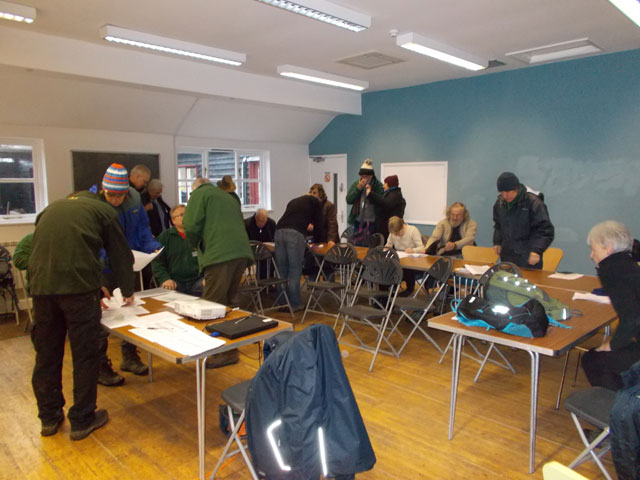
On a bitterly cold day, twenty one rangers turned up for the volunteers meeting at the Visitor Centre last Friday.
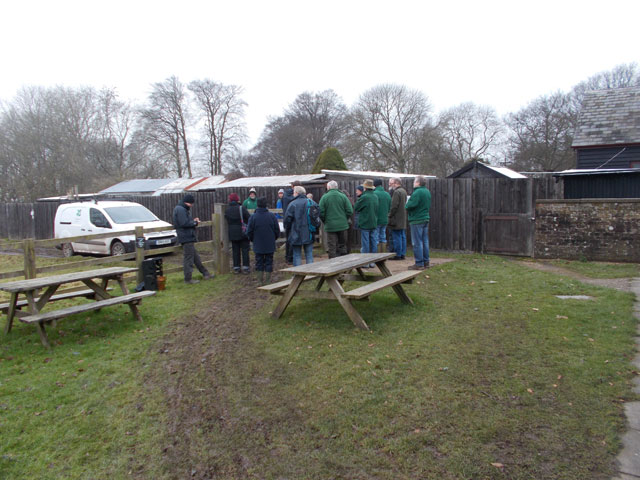
Ben outlined the latest aims and objectives of the Trust as far as rangers are concerned, with new documents and maps. It was an interactive meeting, with an outdoor session looking at typical problems of rights of way. On the new aspects of the ranger role at Ashridge, the Trust would like to encourage us to individually adopt or take responsibility for one or more Estate zones. This will hopefully help individuals find a sense of pride in their own patch, will ensure a coverage of the whole Estate, and improve efficiency. There is no enforcement on individuals who may not wish to cover particular areas, and Ben reminded the gathering of the need to enjoy the role of the volunteer ranger. As a consequence a schedule of named individuals has been produced covering the fifteen Estate Zones.
Managing rights of way on a regular basis is a key aim of the Trust, and a Role Guideline has been produced so that Ashridge can be more pro-active with maintenance. Rangers would undertake the tasks of clearing around way-mark signs, and the trimming back of vegetation on legal rights of way – footpaths and bridleways but not on other paths. Litter picking and the cleaning of signs in car parks is also included in the role of the ranger, and the condition of gates and fences would also be part of the remit.
Engaging with the visitors and dealing with difficult situations is another key issue for the Trust. Rangers are expected to be advocates for Ashridge, speaking to and assisting the public, but they are not required to police the Estate. To this end a Guideline for Managing Incidents has been issued covering specific eventualities, but rangers are not expected to try to enforce the legal rights of the Trust and should report any incidents. To help implement this role the Trust will be producing specific leaflets for walkers, dog walkers, horse riders and bikers which can be handed out by rangers to support their actions. The leaflets will outline the legal rights of the Trust and the public. Where visitors require a permit or licence for their activities it is quite reasonable for rangers to ask to see their pass.
Where issues of concern have occurred, we are required to report the incident by email to five stated recipients, with a photograph if possible using the format on the Reporting Form.
Looking to the Spring, Emily is planning an early-morning sortie to Northchurch common, to engage with the dog walkers, explaining the required code of conduct when exercising their animals. As far as commercial dog-walkers are concerned there will be a licensing system in place by then. In a positive move towards bikers, it is hoped to develop a circular route around the Estate dedicated to cyclists.
To view the maps on the blog click on the option “Maps & Documents” on the navigation bar or use the individual links below.
Pitstone Common Wood, now known as Sallow Copse, close by to Ringshall was the venue for the Thursday volunteers, on the coldest day of the year. The forestry team had been in earlier to cut down silver birch, which has been encroaching on older established trees – oak and beech which will become the veterans of the future. The work is known as halo clearance which allows specimen trees to develop unaffected by encroaching secondary growth. It is carried out in stages so that the trees are not exposed to life threatening changes. The volunteers cleared the branches into piles for habitat improvement, and the resulting timber will be sold off for firewood.
Pitstone Common Wood, part of the extensive Pitstone common extending down to the Mansion and beyond, has a long history of tree felling, with altercations between landlord and tenant. Although a common wood open to the people of Pitstone, it was guarded against exploitation by strict regulation going back to the 1300’s. Many of the local landowners and smallholders had rights to firewood and timber in the wood which was known as “hillwork”. A 14th century source detailed the number of cartloads of firewood as opposed to timber, which could be extracted from the wood.
Disputes relating to Pitstone Wood between local lords and smallholders in Pitstone, and the monks of Ashridge were arising from the late 15th and early 16th centuries.
A group of freeholders from Pitstone petitioned the King around 1500, complaining that the Rector and Convent of Ashridge had illegally extracted five hundred cartloads of wood. Following the dissolution of the monastery a certain Richard Warde, Cofferor of the Queen’s Household who held the land, started selling off the timber. This led to a confrontation with the tenants who threatened the foresters, and they removed thirty loads of timber which had already been felled.
When the Bridgewaters arrived, Sir Thomas Egerton in 1607 was made aware of a communal “hewth” or felling of trees which was about to take place by the commoners. The issue was decided in the Court of Common Pleas in favour of Egerton, where the key tenants as protagonists faced charges of unlawful assembly, riot, and the bearing of unlawful weapons. Despite the verdict the issue of tenants rights remained unresolved.
Pitstone Common Wood still extended to some three hundred acres, and the subsequent history of the tenants’ wood is defined by the gradual consolidation of holdings into larger units and fewer hands, with rights being sold.
The 7th Earl of Bridgewater (1803 – 1823) with his policy of expanding Ashridge bought up these rights. Finally around 1820 the last holder, a certain Thomas Maunder who lived in Aldbury sold his holding to the Bridgewaters for a sum of £1000 – a small fortune in those days.
Climate change is in the news again, as 2016 is likely to be the warmest year on record since 1880. So how is this affecting us at Ashridge? Climate change is disrupting the seasonal behavior of Britain’s countryside. Spring seems to arrive earlier each year while Autumn drifts into December, pushing our flora and fauna to adapt or disappear. As far as wildlife is concerned climate change has already led to the vanishing of some bird species in parts of England, where intensively farmed land gives them no room to adapt to warming temperatures. The revelation, in a new scientific study, contradicts previous suggestions that birds are tracking global warming by shifting their ranges. The research found that birds that prefer cooler climes, such as meadow pipits, willow tits and willow warblers, have disappeared from sites in south-east England and East Anglia, where intensive crop growing is common. “Birds are facing a double-edged sword from climate change and declines in habitat quality,” said Tom Oliver, at the University of Reading, who led the new study. “In England, birds really look like they are struggling to cope with climate change. They are already being hit with long-term reductions in habitat quality and, for the cold-associated birds, those losses are being further exacerbated by climate change.”
“Climate change is with us, here and now, and its effects on wildlife are increasingly well documented,” said Mike Morecroft, principal climate change specialist at Natural England, and part of the research team. Simon Gillings, at the British Trust for Ornithology, and another member of the research team, said: “Intensive [land] management is making it harder for cold-associated birds to find cool corners of sites, or to disperse away from warming regions. “But Oliver noted that showing the impact of climate change on wildlife is affected by the availability of good habitats means action can be taken: “We are not completely at the mercy of climate change.” Creating larger natural areas in strategic places will help species cope with a changing climate, the scientists said.
The study, published in Global Change Biology, analysed both bird and butterfly data from more than six hundred sites monitored between 1964 and 2009. It found butterflies were adapting much better to climate change than birds, although cold-associated butterfly species also suffered if the area around the site was poor in natural habitat.
But while many of the butterfly species that enjoy warmer weather were thriving, birds associated with warmer temperatures were not, due to lost or degraded habitat.
Oliver said butterflies were faring better as they require much smaller areas of natural land, which are more likely to be available. Good habitat means more suitable food plants and more microclimates in which species can thrive in good years and survive in poor ones. The ringlet butterfly, for example, suffers badly in drought years. But they can hang on if there are patches of broadleaf woodland available, as these resist droughts and keep soils more moist than treeless landscapes.
Butterflies can also produce many generations in a single year when conditions are favourable, whereas birds reproduce more slowly. The small copper butterfly can have up to five generations a year, Oliver said.
Like butterflies, dragonflies and damselflies are generally adapting well to climate change and warming has brought eleven new species to Britain since 1995, according to a new report from the British Dragonfly Society. Newcomers include the stunning large white-faced darter and Genevieve Dalley, at the BDS, said: “These unprecedented events currently happening in the dragonfly world are exciting but also act as a warning: the natural world is changing.” But global warming is also threatening the northern damselfly, restricted to a few small lochs in Scotland, and the black darter, which is becoming less common in the south of Britain.
The scientists conducting the bird and butterfly research determined the temperature favoured by each species by looking at the average warmth of their ranges across Europe, with those preferring heat found mostly in southern Europe and vice versa.
Stopping the destruction of habitat such as hedgerows and old orchards and creating new nature reserves can give opportunities for wildlife to adapt to global warming said Oliver. But biodiversity across England continues to fall, he said, despite a landmark review of wildlife sites for the government in 2010.
“That report called for a step change in nature conservation,” said Oliver. “We are still waiting for that step change and until we see it we can’t really expect the fortunes of our wildlife to change.”
Richard Bradbury at the RSPB and not involved in the new research said: “Making use of the tremendously rich wildlife data collected by dedicated UK volunteer observers, this study provides further compelling evidence that climate change is already affecting the UK’s species.”
This illuminating piece was recently published by the Guardian which we are free to disseminate.
How are we faring at Ashridge? Well we have asked Lawrence to let us have a run down on the bird and flower surveys carried out by Ashridge volunteers last year. Watch this space.
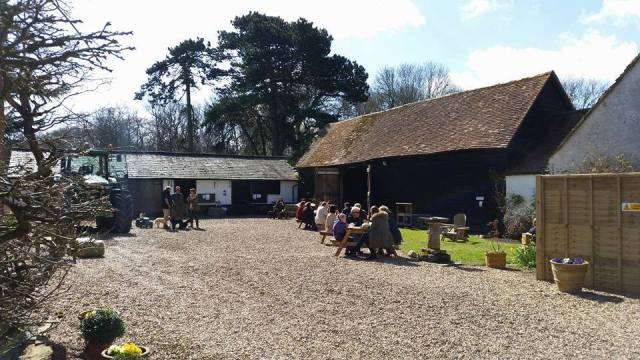
Some of you joined me last July for a super morning in the barn at Hill Farm for tea and cake.
The barn now has planning permission for a cafe and they are planning to open on 1st April. I was wondering if there are any of you who might fancy a change from your usual volunteering to volunteer there too??
Unfortunately I don’t think it will count towards your volunteer hours, just as something different and an opportunity to meet different people in a social way. The menu is small and the coffee machine is easy to use!
Leigh, the farmer’s wife is planning to open at weekends initially, and would probably need two people per day. I’ve said I would be happy to help and if you fancy joining me please get in touch via barbara306@sky.com
Once it’s up and running maybe we could have another tea /cake morning there – please let me know if you fancy coming.
The venue is a useful satellite which visitors can use when the cafe at the Visitor Centre is over-crowded, and the N T at Ashridge are supporting the new venture.
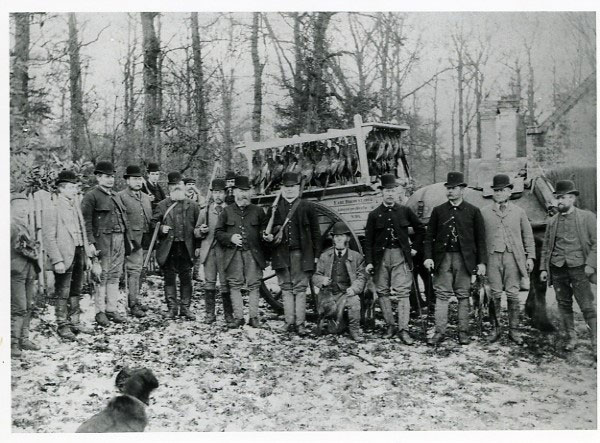
A hundred years ago it would not be uncommon for volunteers to meet up with royalty and the great and the good, as part of a shooting party. Ashridge shooting parties were famous, drawing prominent guests over the years including King Edward VII and King George V, and most of the royal dukes, though in their later years both Lord and Lady Brownlow came to regard such parties as social obligations rather than pleasures. About fifty keepers, most wearing a green livery with silver buttons bearing the earl’s crest, were employed on the various parts of the estate in Little Gaddesden, Ringshall, Aldbury, Dagnall and Studham, under a head keeper and a deputy. The beaters were mostly workers on the Estate, and they were dressed in white smock coats and wore red caps. A glance at the earl’s game book for 1912 shows that over a three-day shoot it was not uncommon for a party to claim up to one thousand five hundred pheasants alone.
It was de rigueur for gamekeepers to wear their bowler hats as part of their uniform – it was a status symbol. The hats were invented in 1850 and served the gamekeepers well, since they did not blow away in a wind, and they were strong enough to withstand a blow on the head from a poacher.
It’s the young lad at the extreme left of the picture in the flat cap, who is the volunteer – probably the son of one of the gamekeepers. If so he would be acting as an unpaid volunteer beater, moving the birds towards the guns, and would hope for a generous tip from the Gentry at the end of the shoot. Mind you, he would not get to keep the reward for it would have to go straight into the housekeeping pot when he arrived home. No impulse shopping in those days!
There is a sting in the tale. (sic)
The picture was taken in December 1899, but where was the location? If you know then please leave a comment.
Thursday morning volunteers again visited the neglected and overgrown area now known as Northchurch Flats – it is far from flat!
The first visit to clear the scrub took place before Christmas, with a record turn-out, and it was expected that further visits would be required to finish the job.
This time the cold weather reduced the numbers to the hard core members only, and fortunately the rain kept off until the afternoon. The intention was to clear out the old Victorian chalk pit adjacent to the road, dug out by the locals around 1880 when it was still part of the common. A chain gang type operation was needed to get the cleared scrub up the sides of the pit for the ritual burning.
The long term purpose of the operation is to “enhance the floristic value of the chalk roadside banks”. It was some years ago that orchids graced the banks of the hollow, which has a micro-climate of it’s own. With the deer reduction program now complete, this should allow the flora to recolonise the hollow. We might even have the return of some brambles to support ground nesting birds like the pheasant. That would be exiting, so let nature get on with it! It will be interesting to see how long it takes for the restoration to be successful, when it will showcase the delights of Ashridge to the passing public.
It was nice to welcome a new volunteer to the group – Anne Robinson. She wrote in to say how much she had enjoyed her induction.
Thanks to Richard Gwilt for his contribution to the article.
Hawthorn predominates amongst the scrub layer covering so much of the chalk hills on the Estate. It is the first to conquer open grassland , and survives for many years quite happily on the thin dry soils of the uplands, where it is despised by wild flower enthusiasts! However it plays an important part in the nature of things, giving cover to nesting birds in Spring, and a regular supply of Winter food to the migrant flocks of Redwing and Fieldfare. This is another one of those symbiotic arrangements of nature whereby two things which are unrelated benefit each other. The tree provides the food for the bird which in turn propagates more trees through it’s droppings. So we can blame the Redwing for the success of the Hawthorn!
In fact common hawthorn can support more than three hundred insects. It is the food plant for caterpillars of many moths, including the hawthorn, orchard ermine, pear leaf blister, rhomboid tortrix, light emerald, lackey, vapourer, fruitlet mining tortrix, small eggar and lappet moths! Its flowers are eaten by dormice and provide nectar and pollen for bees and other pollinating insects. The haws are rich in antioxidants and are eaten by the migrating birds, as well as small mammals.
Also known as the May-tree, due to its flowering period, it is the only British plant named after the month in which it blooms. Flowers are highly scented, white or occasionally pink with five petals, and grow in flat-topped clusters.
In Britain, it was believed that bringing hawthorn blossom into the house would be followed by illness and death, and in Medieval times it was said that hawthorn blossom smelled like the Great Plague. Botanists later learned that the chemical trimethylamine in hawthorn blossom is also one of the first chemicals formed in decaying animal tissue, so it is not surprising that hawthorn flowers are associated with death.
Common hawthorn timber is a creamy brown colour, finely grained and very hard. It can be used in turnery and engraving, and was used to make veneers and cabinets, as well as boxes, tool handles and boat parts. It also makes good firewood and charcoal, and has a reputation for burning at high temperatures as the volunteers will testify.
The haws can be eaten raw but may cause mild stomach upset. They are most commonly used to make jellies, wines and ketchups.
So what’s not to like about the hawthorn? It’s a question of degree, when the extent of the grassland versus the scrub is decided by the Ashridge team with the help of Natural England, which in turn keeps us volunteers in a job!
Mary Webb 1881 – 1927
How sweet a thought, How strange a deed, To house such glory in a seed– A berry, shining rufously, Like scarlet coral in the sea! A berry, rounder than a ring, So round, it harbours everything; So red, that all the blood of men Could never paint it so again. And, as I hold it in my hand, A fragrance steals across the land: Rich, on the wintry heaven, I see A white, immortal hawthorn-tree.



 Ashridge Volunteers