Plant Fair 2017


Dear Volunteers

As many of you are aware, I have taken over the co-ordination role of the National Trust Plant Fair from John Cartwright. He has left rather big boots to fill after many years of successful Plant Fairs so a big thank you to John! I will do my best to keep up John’s good work!

We Need Your Donations of Plants!

fair_2017

The biggest challenge of organising the Trust Plant Fair is ensuring a supply of enough quality plants to sell. To this end, as you continue to clear your gardens for winter and you find that you have plants needing to be thinned or removed, please would you think about donating them rather than deploying them to the compost heap. The only stipulation for donated plants is that they are healthy and well rooted as well as labelled.

No contribution is too small and all contributions are gratefully received. Donations can take the form of perennials, shrubs, vegetables, herbs or small trees or even house plants. If required, I can supply all compost and pots for the potting up of the plants.  Alternatively, if you unable to pot up, just let me know, and I will collect the bare root plants from you.

If you are able to support this year’s Fair by supplying a few plants, please do get in touch with me. The best way to do this is via e-mail, s.djones@btinternet.com.

In order to ensure everyone is in the loop about this year’s Fair, here are a few briefing details:

Date of the 2017 Fair

This year the date of the Plant Fair has moved back a week and will be held on Sunday 21st May. All other venue arrangements remain unchanged.

Pots and Compost

As with previous years, for those needing pots and/or compost, these are available to you. Between the three committee members of John, Jaki and myself, we have sectioned up the general area that our growers tend to cover. If, therefore, you are unable to collect the resources you need, please contact the relevant person to your area and we will deliver to you:

Jaki Smart  – the areas of Hemel Hempstead, Kings Langley and St Albans. Contact smart42@btinternet.com

John Cartwright – Berkhamsted, Frithsden, Potten End and Luton. Contact cartwrightjw@btinternet.com

Me  – Ashridge, Tring, villages between Ashridge and Dunstable as well as Dunstable. Contact s.djones@btinternet.com.

Cold Frame

The cold frame at Ashridge College will remain the collection point for the plants before the Fair. This will open to start assembling plants from the first week of April.  If circumstances dictate and you need to drop plants earlier, please let me know and I will make arrangements for this. Where possible, if you are able to hold on to your plants, it does make things easier as typically the cold frame continues to be used by the College up until the end of March.

Again, as with the compost and pots, when the time comes, if you need help with transporting plants to the cold frame, then please let the relevant person know and we will be only too happy to help.

Spreading the Word

Finally, I have attached a flyer promoting our constant need for new Growers for the Fair. I would be most grateful if you could please either print out or e-mail on to anyone who is a keen gardener and might be able to help this good cause. In order to keep them up to date with developments, if they could then make contact with me, I will ensure that they included in all future communications. 

Any queries at all, please do get in touch.

Many thanks to you all and happy gardening!

Sarah
Posted in Events, Flora and Fauna, Personal Messages | 1 Comment

Calling all Rangers


This slideshow requires JavaScript.

Rangers have been invited to a meeting at the Visitor Centre on Friday 27th January at 2.00pm., which is a change from the original date of January 20th. The gathering will include a short walk around the Estate to view the problems of maintaining rights of way.

As discussed at the last meeting, the Estate has been divided into fifteen zones so that individuals can be assigned to particular areas to avoid the overlapping of effort. If you want to be allocated a particular zone, please email Ben at ben.newton@nationaltrust.org.uk

A map of N T car parks with designated names has also been circulated to make it easier to identify places on the Estate. Guess how many there are; ten? no. twenty? no. thirty? nearly! They vary in their size and use, but all present a problem with litter and fly-tipping.

The last meeting of Rangers on November 8th was attended by nineteen volunteers! There was a packed program and the details were distributed in a lengthy “Note”.

These are rewarding times to be a Ranger, with increased responsibilities being offered by Ashridge. Not just to be the eyes and ears of the Trust, but taking the key role in the “people facing” function, for those that seek it. An Anglicised version of the American style of  “meet and greet”. Engaging with the visitors to make a difference to their visit, and being able to make on the spot judgements on  situations like the picking of wild flowers, or using one’s initiative by removing stinging nettles or deadly nightshade from busy areas.

Happy days.

  • The maps are available on line by accessing the navigation bar above.
Posted in Archeology, Charcoal, Events, Flint wall group, Flint Wall Volunteers, Flora and Fauna, Fly Tipping, History, Litter Picking, Personal Messages, Sunday Group, Thursday Conservation Group, Volunteer Rangers, Walks, Why I Volunteer, Wildlife, Windmill | Leave a comment

Holiday Heaven


This slideshow requires JavaScript.

Visitors took advantage of the good weather on Monday, the last day of the Christmas holiday for many, to take in the air at Ashridge.

Despite the muddy ground conditions some four hundred and fifty vehicles were parked at any one time along Monument Drive, clogging up the road as is usual at holiday times.

Over at the Beacon, the car park was full to overflowing as people took to the circular walk along the headland from the hill and around to the Coombe. This route has become a regular haunt for many local walkers and is fast becoming like a Victorian promenade! There were at least a hundred walkers on the route at one point in time! The two and a half mile walk is physically testing, but ideal for those wishing to stroll amongst the amazing countryside, and tip toe through it’s early history. The Beacon landscape has not changed much in a thousand years – it has always been a sheep-walk. Today you might find some five hundred Southdown sheep on the hills, but three hundred years ago before the land was enclosed by the Bridgewaters there were thousands more, along with their shepherds. It was common land allowing the people of Ivinghoe Aston to freely graze their livestock.

Three thousand years ago our iron-age ancestors lived at the top of the Beacon in their hill fort!

For four hundred years or more, the drovers carved out their hollow-ways around Piccadilly Hill , climbing up to the Ashridge estate.

In the Stuart period when the Bridgewaters purchased the Estate from the Crown in 1604, the level area below the hill was used as a racecourse – drovers, gypsies and the gentry raced their steeds there.

Scroop the first Duke of Bridgewater (Ashridge 1701-1745) had some one hundred and fifty horses on the Estate, including race horses and no doubt trained them on the course. Mr Ellis from Church Farm in Little Gaddesden tells us in the early 1740’s that a certain Mr Hearne, a gypsy who lived a while at Brick Kiln cottage on Berkhamsted common along with some thirty compatriots, was “full of money”, and kept a couple of race horses. He ran a little black bay-horse against a Gentleman’s large grey at Ward’s – combe, and won a great deal of money by a particular “bite”. (A cunning plan). His horse in the first race was restricted in it’s gallop, and he lost the race. So a large amount of money was wagered by the “locals” on the second race expecting a similar outcome, but the restrictive harness was removed from the bay-horse without their knowledge, and Mr Hearne won the race easily. The cunning plan had worked and Mr Hearne had cleaned up!

We are therefore mindful of the fact that these hills really are a special place, and that it is the visiting N T members who are indirectly paying for the upkeep of this landscape through their membership fees, without forgetting the free contribution made by the conservation volunteers.

Posted in Flora and Fauna, Thursday Conservation Group, Wildlife | 2 Comments

A Regal Message


This slideshow requires JavaScript.

For those of you that have missed it , and there must have been a lot if the response figures are a judge, Helen Ghosh the Director General put out a Seasonal message to volunteers on the myvolunteering web site.

During the year the N T has been dogged by some bad press from the left wing media for it’s handling of events – executive pay, money-making schemes, pop-up events, and land purchase. These events have been a distraction from it’s core purpose of conservation, with a possible dumbing-down by wishing to be “inclusive”. Volunteers have even been described as devout and fervent followers!

However the D G was upbeat and not at all defensive about events, stating the need “to focus on our core purpose and move forward together with local communities with other opinions, towards the common cause that we have”. Conservation is about managing a process of change. “In the end the success of what we do depends on the energy, commitment and skills of the staff and our volunteers”. We need to “move, teach and inspire the visitors and engage with them in what we do to maintain their support for us in the future”. She reminds us that “we are not just a visitor attraction but we have a need to look after our special places for ever and for everyone”.

So we have added a greeting on the video on behalf of the Blog – the only comment so far!

Do have a look at the message from the Trust  – a regal performance. It will only take up ten minutes of your day! The password to access the video is on the message.

Myvolunteering.nationaltrust.org.uk

Posted in Personal Messages | 1 Comment

Roll on 2017!


This slideshow requires JavaScript.

To all card-carrying countryphiles.

If you can believe the press, most of the 82% of the nation who live in built up areas subscribe to Christopher Marlowe’s Passionate Pilgrim – an idyllic vision of rustic romance beyond the greenbelt:

 Come live with me and be my love,/ And we will all the pleasures prove/That hills and valleys, dale and field,/And all the craggy mountains yield./There we will sit upon the rocks/And see the shepherds feed their flocks,/By shallow rivers , to whose falls/Melodious birds sing madrigals.

Whilst city dwellers might feel uncomfortable living in the countryside they still want to take in the beauty and fresh air on occasions, as a pleasure. Visitors flock to our Ashridge acres because it is an oasis of picturesque calm, outside of the regular hustle and bustle of everyday life – they look for quiet enjoyment.

Four hundred years ago when Marlowe penned his poem, it was only the likes of the Bridgewaters who had much time or regard for pleasure and enjoyment at Ashridge, unlike today. So we must no doubt expect even greater numbers of visitors in the New Year. The townies will soon be coming for the green shoots of Spring pushing up through the earth, bursting buds on the trees, the bluebells and gamboling white lambs, and the bosky valleys full of melodious birds singing madrigals.

With this in mind , the volunteers will be recording the demographics of the visitors over the next few months, to help the Trust plan for the expected influx.

Happy days to you in the year ahead.

Posted in Events, Flora and Fauna, History, Sunday Group, Thursday Conservation Group, Volunteer Rangers, Walks, Why I Volunteer, Wildlife | Leave a comment

Bee Bread?


This slideshow requires JavaScript.

Bumble bees build a pile of pollen, then mix in honey to make their bread!
What do bees in general get up to in winter time – how do they hibernate?
Although honey bees and bumble bees are closely related, their winter behaviour is very different.
A colony of honey bees will live throughout the entire winter, actively keeping the hive warm and safe. Although a winter colony is much smaller than a summer one when it can hold up to fifty thousand bees, it will nevertheless contain thousands of individuals. They eat and work all winter long—activity which requires a large cache of stored food.
Bumble bees on the other hand do not maintain colonies throughout the winter. Instead, the last brood of the summer colony which might hold up to four hundred bees, will contain a number of queens. Each of these queens will mate and then find a home in which to overwinter, in a hole in the soil a few inches down. Only the queen bumble bees hibernate until spring.
While the bumble bee queen hibernates she is neither eating nor working. Her depressed rate of metabolism allows her to live for long periods while burning very little energy.
In the spring, she must work hard. She begins by finding a suitable nesting spot, then builds a “honey pot” from wax and will use it to hold a small store of honey. She will also collect pollen, and make a pile of pollen mixed with honey called “bee bread.”
Now here is where it gets weird. Much like birds, the queen bumble bee will lay her eggs on the “bread” and then sit on them to keep them warm. During the development of the young bumble bees, the queen will eat the honey she stored in her pot.
The first batch of young bees will be mostly workers—bees who can take over the household chores and the foraging while the queen continues to lay eggs. Later in the season, she will lay some eggs that become queens and drones. These bees will be the ones that are responsible for the next generation, with the drones only living for a few weeks.
This life cycle is found in bumble bees throughout the temperate regions of the world.

bumblebeeconservation.org/

Posted in Volunteer Rangers, Wildlife | Leave a comment

Christmas crackers 1843!


modamoda2

Greetings, and a very merry Christmas to all of our followers.

Culture and custom is what we celebrate at Ashridge.

We are probably all aware that Prince Albert , husband of Queen Victoria is credited with popularising the Christmas tree in England in 1841, so what of the history of the Christmas card you may ask.

The tradition of sending Christmas cards began in 1843 with the commission of a card by an influential entrepreneur, Sir Henry Cole, who is credited with devising the concept of sending greetings cards at Christmas time. The Victorians embraced this new tradition, but the first Christmas cards rarely showed winter or religious themes, instead there were sentimental images of children and animals, flowers and fairies.

Recent research has found that designers of Christmas cards during this period used fine art on their products as there was concern that the festival was becoming commercialized. Nothing has changed then. The use of fine art in an affordable product was also a means to inform the average, middle-class consumer (that’s us) of the aesthetic value of the decorative arts.

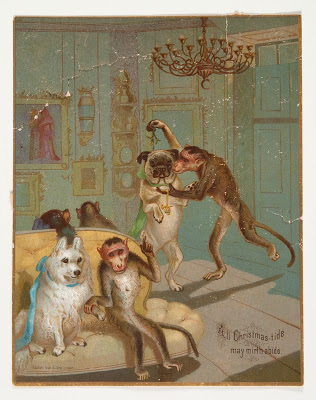
The strangest card in the collection at the Museum of Domestic Design and Architecture, is one featuring a monkey and a dog under mistletoe. It is certainly very unlike any that you will have received this year.

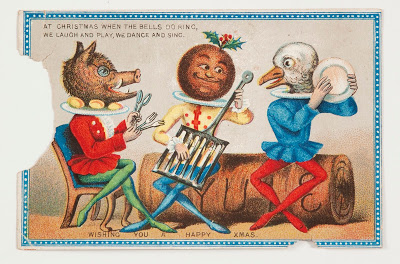
Equally bizarre is the card featuring characters sitting on a yule log with a hogs head, a goose head and a Christmas pudding head, playing kitchen implements as instruments.

At Ashridge some one hundred years ago, families from the Estate were no doubt delighted and relieved to receive their customary gift from the Brownlows – a joint of home-killed beef. There was two pounds for each adult and one pound for each child, so ten pound joints were not uncommon.

Compliments of the Season to you all.

The Christmas cards are from the Charles Hasler Collection – thanks to MoDA.

Posted in Events, History | Leave a comment

Virgin Scrubland


This slideshow requires JavaScript.

On part of the extensive Northchurch common, lies a small area untouched and unloved for decades. Like a corner of a foreign field, part of a common that was exploited over the centuries for livestock grazing and chalk extraction is today virgin scrubland. It lies between Northchurch Farm and Northchurch House, along the road leading down to Northchurch, formerly known as Berkhamsted St. Mary.

The volunteers have now moved in to retake this neglected corner of the Estate. There is a need to thin out the established hawthorn scrub to allow the light to bring back the ground cover which has been destroyed by grazing deer. There may then be a return of ground nesting birds like the native pheasant which is a rare sight at Ashridge these days. It is not that long ago that tree pipits and nightjars frequented the common.

Last Thursday the heavy staff brigade arrived with their machines, with Caleb, Pete and Ben taking out the large material. It was mostly coppiced, but a couple of trees were pollarded, which is a welcome sight considering there are so few new pollards in Ashridge. Then the light brigade in the form of the volunteering army arrived in record numbers to collect and burn the scrub. Some of the brushwood from the felled trees was taken out to fashion the now familiar dead -hedge, along the access road to Northchurch farm. The Estate Office arrived in force, with Emily, Laurence and Susie giving thanks and seasonal greetings, and some mulled wine, whilst Christmas foods were exchanged amongst the army. The area is far from cleared so the army will no doubt return in the New Year.

Posted in Thursday Conservation Group | Leave a comment

Ashridge Volunteer Forum


This slideshow requires JavaScript.

Well over fifty volunteers attended the Christmas coffee morning, at the Aldbury Memorial Hall last Friday. It was standing room only for latecomers. Volunteers can look forward to at least six Forums in the New Year according to the new timetable.

Christmas greetings were handed out in the form of cards, coffee and cake, served up by Janet and the volunteers and ably supported by staff members.

Susie Mercer presented the Trust’s achievements for 2016, and took questions on the proposed plans for next year, supported by Josh and Ben. Notable achievements mentioned were the deer cull with a target of six hundred, and the fact that new species of plants have already appeared in the woods. The £6k taken at Dockey Wood for viewing the bluebells, the target of two hundred and seventy new memberships having already been met, the good year for the Windmill with the publication of a dedicated book, and the record attendance at the Monument. The second horse fun ride attracted some eighty riders, and those attending the deer rut exceeded one hundred and thirty. The film crews put in their regular appearance creating some £28k in revenue.

It was pointed out that the Friends of Ashridge were still operating as a going concern for those who wish to contribute funds to Ashridge. The funds accumulated over the last twelve years amounting to over £30k have been earmarked for the extension to the mobility track around Meadley’s Meadow, which is awaiting planning permission.

The new organiser of the Plant Fair was introduced – Sarah Jones. She will be running the event in May, along with John Cartwright who is retiring as the organiser. Sarah would like to receive calls from anyone able to supply plants or cuttings, for next year’s event. Her mobile number is 07774 1916817 or email at s.djones@btconnect.com.


Posted in Events | Leave a comment

Children’s Trail


This slideshow requires JavaScript.

Volunteers are supervising the Christmas trail taking place on the three weekends before Christmas, and the one weekend thereafter. The course runs around the outside of Meadley’s meadow, and the theme this year is based on woodland creatures preparing for Winter and getting ready for Christmas. “Homes” have been created and displayed around the course, with each one having a notice board explaining the feature, written in poetic verse. The aim is to guide a robin to it’s party venue at the last display. Three of the displays are sensory including touch, smell, and sound, which has proved a big hit with the children. They need to put their hands inside a bauble and guess the contents. Each “home” features a different wild native including the robin, a squirrel, hedgehog, deer, fox, shrew, owl, glis glis, stoat, bat and badger. The final display is the robin’s party site with four small houses. With high numbers of visitors there has been lots of praise from the parents, the presentation considered to be the best yet . The cost per child is £3, with dogs and the like going free. An American skunk was seen trying to get into the action!

Thanks to Richard Gwilt

Posted in Events, Walks, Wildlife | Leave a comment