
The Beacon produced some interesting litter this weekend in the form of three polystyrene planes one of which belonged to a Mr Trump. They were not up to the job, became damaged and left behind.

The Beacon produced some interesting litter this weekend in the form of three polystyrene planes one of which belonged to a Mr Trump. They were not up to the job, became damaged and left behind.
Ten members of the Thursday group took up their paint rollers to maintain the metal Park fence at Little Gaddesden, last painted many years ago.
In the 1800’s much of the Park was enclosed with this type of fencing, and the Trust would like to reinstate it – the Forth bridge comes to mind. The original fence line was further into the Park, when the hay meadow formed part of the common green. It was enclosed by the Bridgewaters, probably by the 7th Earl John William or his widow, certainly before 1833. No resolute resistance took place by the inhabitants of Little Gaddesden to this encroachment. A Mr Lane writing in 1854 attributes the encroachment to Lord Bridgewater. He said “the enclosure of the portion of the Park which runs parallel with the road thro’ the village was not done without some resistance.”
Nearby is Blue Pot pond , opposite the Manor House which was used by the villagers during the 19th century for drinking water!
Some twenty volunteers attended the garden visit at Ashridge House last Wednesday, along with Lawrence and Bob representing the Trust – the immediate neighbours. Ashridge House relies upon the goodwill of the Trust to secure the various vistas from the House.
This is the garden for which the Mixed Style was first advocated, by Humphry Repton in his Red Book of 1813. Repton described his design as the ‘child of my age and declining powers’. He proposed fifteen different types of garden. After Repton’s death, his proposals were adapted and implemented by Sir Jeffry Wyatville. As Repton wished, there is a notable mixture of features: an Italian garden, a circular Rose Garden, a Monk’s garden and Holy Well, an Armorial Garden, a conservatory, a grotto and an avenue of Wellingtonias leading to an arboretum. Repton proposed various elements for his pioneering Mixed Style garden: a Lawn; a Pleasure Ground; a Holy Well; a Pomarium; a Monk’s Garden; an Arboretum; a Magnolia and American Garden; an Embroidered Parterre; a Grotto and Garden for Rock Plants; a Cabinet de verdure; a Mount Garden; a Rosarium and Fountain; Connecting Interior Walks; an Open Terrace and Exterior Walks. Many of these features became classic elements of Victorian garden design. Much of his work still remains today, and much has been replanted.
Katy from the Estate office took the opportunity to visit, on her last working day at the Trust – we wish her well for the future.
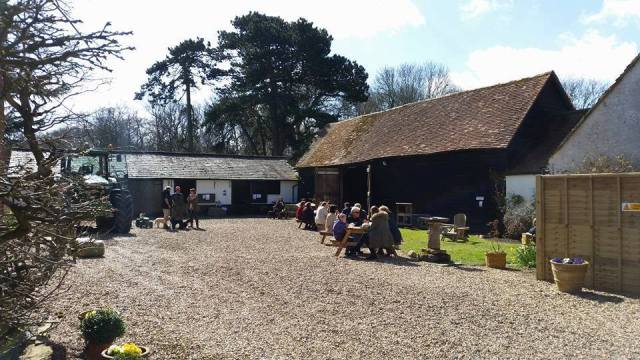
Babs had the bright idea of inviting all volunteers to a get-together at Hill Farm last Monday morning. Some twenty people attended from all the different volunteer groups, spending an hour talking over points of interest. This was an attempt to unify the volunteers, many of whom rarely have a chance to meet their kindred spirits.
Hill Farm is a tenanted part of the Ashridge Estate with some three hundred acres of arable land and some woodland. It is on the New Road from Ringshall to Northchurch @ SP979101 They have plans to turn it into a rural learning centre , and open it for teas, which has the support of the Trust. A flower meadow is also planned for next year.
The next volunteers meeting is scheduled for Monday 15th August at 11.00am, this time at the Visitor Centre, when refreshments will be provided by our Janet.
Some lovely shots of Clipper Down and Pitstone Hill on a summer’s day.
On Thursday the team were removing more of the wire netting from the redundant fence line, but the gate posts proved to be immovable.
Clipper Down is let out to Mr Roe at Down Farm, who in turn lets it out the grazing to Mr Leach of Town Farm for his sheep. Lawrence may well have plans for more intense grazing here to encourage the wild flowers – an early gentian and bee orchid were recorded this year.
How to make charcoal – easy peasy!
The charcoal burner’s trade secrets were handed down from one generation to the next, and charcoal fired the early Industrial Revolution until it was replaced by coke. As a woodland industry it started to die out by the end of the 19th century. This ancient occupation has been resurrected in recent years , and can now be replicated on a small scale as demonstrated at the recent Big Camp event at Ashridge.
The volunteers made use of the plentiful supply of timber from the Estate, like ash and beech, which produces a far superior charcoal to that imported from overseas. It is of course a sustainable product, and is sold at the Visitor Centre for barbecues.
For a detailed explanation of the process please click here
Ashridge supports a number of rare flowers, mainly on the chalk downland like the fleawort and early gentian. However there is one rarity which hides away in the deep shade of the beech woods – the violet helleborine. Harding’s Rookery is home to this elusive orchid which tolerates deep shade, but needs protection here from the large resident deer herd.
Every year the Trust, along with the help of volunteers builds brushwood pyramids to conserve the plants. The flower is pollinated by wasps and the plant is dependant upon a certain soil fungus being present to enable it’s seeds to germinate – it cannot be successfully moved or translocated.
It gets it’s name from the purple markings on the leaves and stems.


Having stripped out the old barbed wire fence running down from Duncombe Terrace, the Thursday team moved onto Clipper Down to take out an obsolete fence line. These old fences are a hazard for the resident deer herd.
With the fence sunk into the ground , it took the brute force of at least six volunteers at a time to remove it.
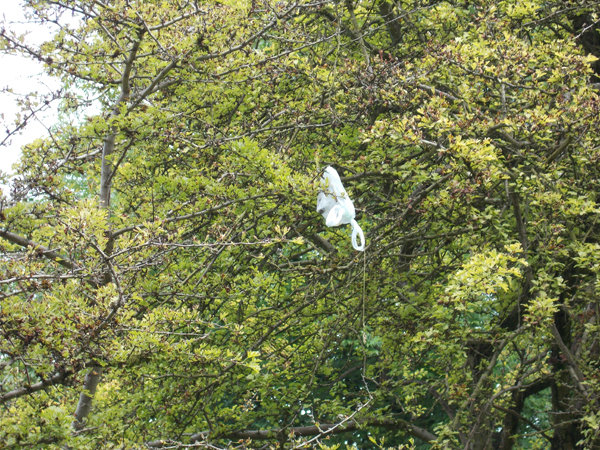
It is hard to understand the mentality of some visitors who take pains to bag their dog’s mess and then throw it into a tree. Plastic bags blight the landscape for years to come.
Visitors need to be aware of the Trust’s policy on dog mess and litter. There are no collection bins provided on the Estate, apart from around the Visitor Centre. Lawrence maintains that bins attract litter and they have to be emptied. Dog mess should be flicked into the long grass where it will decompose, and will not be a nuisance to others. If it is picked up in a bag it must be taken home for disposal, along with personal litter. We expect the Estate to be litter free which is part of the visitor experience.
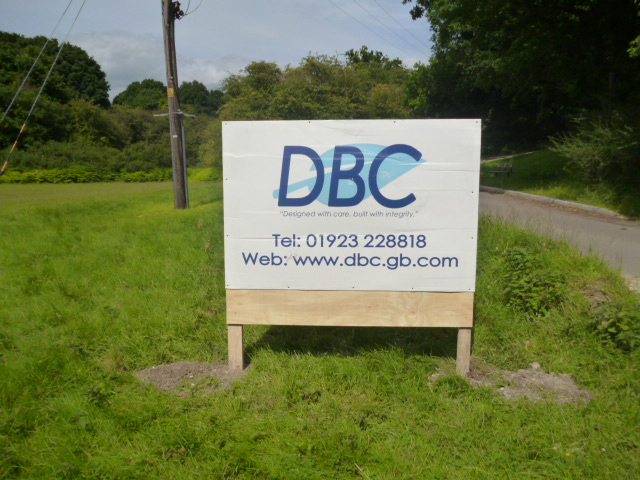
This advertising sign appeared overnight on the New Road coming up the hill from Northchurch, and was spotted by Richard our Volunteer Ranger. The Trust were informed and it quickly disappeared.
The sign was “designed with care and built with integrity” – no moral principles at D B C then.
 | ashridgevolunteersbl… on SHEER JOY… |
 | Anonymous on SHEER JOY… |
 | Richard Gwilt on WELL-BEING… |
| ashridgevolunteersbl… on What’s going on?… |
| Anonymous on What’s going on?… |
 Ashridge Volunteers